Hotel en
 Medische keuringen beschikbaar bij het afrekenen

28 Nov 2026


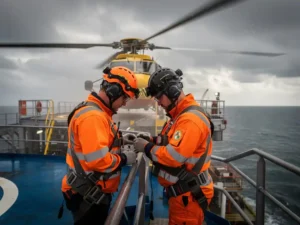
Night operations significantly increase helideck crew requirements. Crews must hold additional qualifications beyond standard daytime certification, and helideck operations at night demand more personnel, specialized lighting knowledge, and enhanced emergency response readiness. The sections below break down exactly what changes when the sun goes down.
Helideck crews working night operations must hold OPITO-accredited helideck training that specifically covers night operations procedures, in addition to their standard Helideck Assistant (HDA) or Helideck Landing Officer (HLO) certification. Night-specific competencies include managing helideck lighting systems, communicating with pilots in low-visibility conditions, and executing emergency procedures in darkness.
The Helideck Landing Officer carries the greatest responsibility during night helicopter operations offshore. An HLO must demonstrate not only the standard competencies required for daytime operations but also a clear understanding of how reduced visibility changes hazard identification, marshalling signals, and coordination with the helicopter crew. Night operations introduce a higher risk profile, and regulators expect the HLO to be trained and assessed against that elevated standard.
Helideck Assistants supporting night operations must also be familiar with their specific roles in a low-light environment. This includes knowing how to operate and inspect lighting equipment, maintain situational awareness without full visual reference, and respond to emergencies where darkness limits reaction time. These competencies are typically assessed during practical exercises as part of OPITO helideck courses.
Night lighting equipment significantly expands helideck crew responsibilities. Crew members must be able to inspect, operate, and troubleshoot all helideck lighting systems before and during operations. This includes perimeter lighting, floodlighting, the helideck status light, and windsock illumination. A lighting failure during an active approach is a safety-critical event that the crew must be prepared to manage.
Lighting responsibilities also affect pre-flight checks. Before any night helicopter operation begins, the HLO must verify that all required lighting is functional and meets the standards set by the applicable regulatory framework. This is not a task that can be delegated informally. It requires a structured inspection process and clear documentation.
When lighting malfunctions occur, the crew must know the correct procedure: whether to abort the operation, notify the installation manager, or implement a contingency. Understanding these decision points is part of the HLO and HDA competency framework for night operations. Practical training that simulates lighting failures is a key component of preparing crews for real-world scenarios.
Night helideck operations offshore are governed primarily by the Civil Aviation Authority (CAA) guidelines, the International Civil Aviation Organization (ICAO) standards, and the operator’s own Safety Case requirements. In the North Sea and many other offshore regions, OPITO-accredited training is the accepted standard for demonstrating crew competency. Operators must also comply with flag state and national aviation authority requirements relevant to their installation’s location.
Key regulatory documents include CAP 437, published by the UK CAA, which sets standards for offshore helicopter landing areas, including lighting specifications, helideck dimensions, and crew requirements for both day and night operations. Operators working in Norwegian waters must also align with the Norwegian Oil and Gas Association guidelines, which reference similar standards.
The regulatory framework for night operations typically requires:
Operators are responsible for ensuring their helideck crew holds current, valid certification that covers night operations. Certificates with gaps in night-specific training may not satisfy a Safety Case audit or an operator’s internal compliance requirements.
Night helideck operations generally require a larger crew than daytime operations. While a single qualified HDA may support an HLO during routine daytime helicopter movements on smaller installations, night operations typically demand at least two Helideck Assistants alongside the HLO. This reflects the increased complexity and risk associated with operating in low-light conditions.
The reasoning is practical. During a night emergency, such as a helicopter incident or a fire on the helideck, the crew must execute a coordinated response faster and with less visual information than in daylight. More personnel allow tasks to be distributed, reducing the risk that a single crew member becomes overwhelmed. Firefighting, communication, marshalling, and casualty management cannot all be handled effectively by one or two people in a nighttime emergency scenario.
Specific crew size requirements may vary depending on the installation type, the helicopter operator’s procedures, and the applicable national regulations. Operators should review their own Safety Case and helicopter operator agreements to confirm the minimum crew complement required for night operations on their specific installation.
The primary training courses that prepare helideck crews for night operations are the OPITO Helideck Assistant (HDA) and OPITO Helideck Landing Officer (HLO) programmes. These OPITO-accredited courses cover both daytime and night operations competencies, including lighting management, night-specific emergency response, and communication procedures with pilots during low-visibility approaches.
The progression for most helideck crew members follows a structured path:
Candidates should confirm with their employer or operator which specific OPITO standard applies to their role and installation. Some operators require additional company-specific assessments on top of the OPITO qualification before clearing a crew member for unsupervised night operations. You can explore the full range of OPITO helideck courses to find the right qualification for your role.
It is also worth noting that helideck crew members working offshore will typically need to hold valid HUET and BOSIET certification alongside their helideck qualifications. These are separate offshore survival requirements, but they are part of the broader compliance picture for anyone working on an offshore installation where helicopter transport is involved.
We offer OPITO-accredited helideck training designed to meet the certification requirements for both daytime and night operations. Whether you are an individual professional working toward your HDA or HLO qualification, or an HSE coordinator managing crew compliance for an offshore installation, we provide the structured training needed to meet regulatory standards.
Here is what you can expect when booking helideck training with us:
Ready to get certified or renew your helideck qualifications? Browse our full range of OPITO offshore courses and book your training today.