Hotel und
 Medizinische Schecks an der Kasse erhältlich
14 Nov 2026


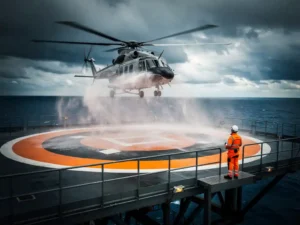
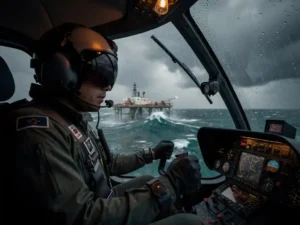
Operating a helideck without a certified crew puts lives at serious risk. Untrained personnel cannot safely manage helicopter landings, emergency responses, or firefighting procedures, making every flight operation a potential incident. The questions below unpack the specific risks, legal responsibilities, and certification requirements every offshore operator needs to understand.
Without a certified helideck crew, even routine helicopter operations carry a serious risk of injury, fatal accidents, and operational failure. Trained personnel are responsible for managing landing signals, fire suppression, emergency response, and crew coordination. Without that expertise, the margin for error disappears fast.
Helideck operations involve multiple simultaneous tasks that require clear roles and practiced responses. An uncertified crew member may fail to recognize fuel leaks, mismanage rotor clearance, or respond incorrectly to a fire on deck. These are not theoretical risks. They are predictable outcomes when people without proper training are placed in high-pressure, safety-critical roles.
Common failure points when helideck crew lack certification include:
Each of these failures can escalate rapidly in an offshore environment where emergency services are not immediately available and conditions can change within seconds.
Helideck crew are required to hold OPITO-accredited certifications that match their specific role on the helideck. The two primary qualifications are the Helideck Landing Officer (HLO) certification and the Helideck Assistant (HDA) certification. Both are internationally recognized and mandatory on most offshore installations.
These certifications are governed by standards set by OPITO, the global offshore safety training body. They ensure that personnel can handle normal operations as well as emergency scenarios such as helicopter fires, crash landings, and passenger evacuations. Refresher training is also required at regular intervals to keep certifications valid.
In addition to HLO and HDA qualifications, helideck crew may also be required to hold complementary certifications depending on their installation and operator requirements. These can include offshore firefighting training and emergency response qualifications, which directly support helideck safety operations.
Legal responsibility for a helideck incident falls primarily on the installation operator and, in some cases, the individual company that deployed uncertified personnel. Regulatory frameworks in most offshore jurisdictions, including those governed by the UK Health and Safety Executive, the Norwegian Petroleum Safety Authority, and equivalent bodies in other regions, require that all safety-critical roles are filled by competent, certified personnel.
If an investigation finds that helideck crew lacked valid certification at the time of an incident, the operator faces significant legal exposure. This can include regulatory fines, operational shutdowns, and in serious cases, criminal liability for negligence. Individual supervisors who knowingly assigned uncertified personnel to helideck roles can also face personal accountability.
The duty of care extends beyond the installation itself. Helicopter operators, contracting companies, and crewing agencies all have obligations to verify that personnel placed in safety-critical roles hold the required qualifications before deployment begins.
Using uncertified helideck crew can invalidate insurance coverage and trigger compliance violations that affect the entire operation. Most offshore liability policies include conditions requiring that safety-critical roles are staffed by certified personnel. If an incident occurs and the crew lacked valid certification, insurers may deny claims entirely.
Beyond insurance, compliance consequences can be severe. Regulatory audits that identify gaps in helideck crew certification can result in operational suspensions, mandatory corrective action plans, and reputational damage that affects future contract eligibility. Operators working with major oil and gas companies are typically subject to client audits as well, where certification gaps can trigger contract termination.
Maintaining valid crew certifications is therefore not just a safety matter. It is a business continuity requirement that protects the operator’s ability to function legally and commercially.
The Helideck Landing Officer (HLO) and Helideck Assistant (HDA) are two distinct roles with different levels of responsibility. The HLO holds overall authority for helideck operations and is responsible for managing all helicopter movements, communicating with the pilot, and directing the response to any emergency on deck. The HDA supports the HLO and is trained to assist with firefighting, passenger handling, and operational tasks under the HLO’s direction.
In practical terms, the HLO is the senior role and requires a higher level of training and demonstrated competence. The HDA role is typically an entry point into helideck operations and forms part of the pathway toward HLO qualification. Both roles require OPITO-accredited training and periodic refresher certification to remain valid.
You can explore the full range of OPITO helideck courses to understand which qualification applies to each role and what the training involves.
Getting helideck crew certified quickly comes down to finding an OPITO-accredited training provider with available course dates, flexible scheduling, and locations that are convenient for your crew. Most HLO and HDA courses run over several days and combine theoretical knowledge with practical drills, so planning ahead is important to avoid project delays.
Follow these steps to get certification in place efficiently:
Booking through a provider that guarantees courses run regardless of participant numbers avoids the risk of last-minute cancellations disrupting your deployment timeline. Check available training locations to find a center near your crew before your next offshore rotation.
We provide OPITO-accredited HLO and HDA training designed for professionals and organizations operating in the offshore sector. Our courses are practical, instructor-led, and built around real operational scenarios so your crew is prepared for what they will actually face on deck.
So sieht die Zusammenarbeit mit uns in der Praxis aus:
Whether you need to certify a single crew member before deployment or coordinate training across an entire team, we make the process straightforward. Browse our OPITO helideck courses and book directly online to get your crew certified without delay.