

 Hotel and
 Medical checks available at checkout
17 Oct 2026
The main difference between T-BOSIET and BOSIET with CA-EBS is the environment they are designed for. T-BOSIET is a tropical variant of the standard BOSIET, built for offshore workers operating in warm-water regions. BOSIET with CA-EBS is the standard course that includes training with a compressed air emergency breathing system for use in cold or temperate water environments. The right course depends entirely on where you work offshore.
Below, we answer the most common questions about both courses so you can make the right choice before booking.
The course you need depends on the water temperature of the region where you work offshore. If you operate in tropical or warm-water environments, such as Southeast Asia, West Africa, or the Middle East, you will typically need the T-BOSIET. If you work in the North Sea, the Gulf of Mexico, or other cold and temperate water regions, the standard BOSIET with CA-EBS is the required course.
Your employer, project contractor, or the operator of the installation will usually specify which certificate is required. Always confirm the requirement before booking, since the two certificates are not interchangeable in most operational contexts.
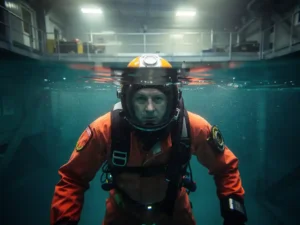
CA-EBS stands for Compressed Air Emergency Breathing System. It is a small, portable breathing device that provides a short supply of compressed air to help a survivor breathe during a helicopter underwater escape. The CA-EBS is used in the event that a helicopter ditches into the water and an occupant needs additional time to escape from a submerged and potentially inverted aircraft.
In cold-water regions, the risk of cold shock and loss of breath control is significantly higher, which is why the CA-EBS is a standard part of the BOSIET training in those environments. Training with the CA-EBS teaches participants how to activate the device, breathe from it correctly, and use it under realistic underwater escape conditions.
T-BOSIET stands for Tropical Basic Offshore Safety Induction and Emergency Training. It is an OPITO-accredited course designed for professionals who work offshore in tropical regions, where water temperatures are typically above 25 degrees Celsius. The course covers the same core survival principles as the standard BOSIET but adapts the training content to reflect the specific hazards and conditions of warm-water environments.
The T-BOSIET is designed for offshore workers, technicians, and other personnel who are deployed to tropical offshore installations. Common regions where this certificate is required include parts of Southeast Asia, West Africa, the Middle East, and South America. If your project or installation operator specifies tropical survival training, the T-BOSIET is the course you need.
Both courses share a strong foundation of offshore survival training, but they differ in specific content areas and equipment used. Here is how the two courses compare:
The practical exercises in each course are tailored to the conditions relevant to the region, which is why they are treated as separate qualifications rather than interchangeable versions of the same course.
No, T-BOSIET and BOSIET with CA-EBS certificates are not interchangeable. Each certificate is recognized for a specific operational environment, and operators and contractors will typically specify which one is required based on the location of the installation. Holding a T-BOSIET does not satisfy the requirement for a BOSIET with CA-EBS, and vice versa.
There are some situations where a professional works across both tropical and temperate regions, in which case they may need to hold both certificates. Always check the specific requirements of your employer, the installation operator, or the project you are being deployed to before assuming one certificate covers all locations.
Both the T-BOSIET and BOSIET with CA-EBS certificates are valid for four years from the date of issue. After four years, certificate holders must complete a refresher course to maintain their certification. The refresher course for the standard BOSIET is called the FOET (Further Offshore Emergency Training), and the tropical equivalent is the T-FOET.
It is important to track your certificate expiry dates carefully. Many offshore projects and operators require a valid certificate before deployment, and an expired certificate can result in delays or being stood down from a project. Renewing your certificate before it expires, rather than waiting until after, keeps your compliance record clean and avoids disruption to your work schedule.
Choosing the right offshore survival course and keeping your certificates up to date does not have to be complicated. We at FMTC Safety offer both the BOSIET with CA-EBS and the T-BOSIET with CA-EBS through our OPITO-accredited training centers, with flexible scheduling that fits around your project timelines.
Here is what you can expect when you book with us:
Whether you need to book a first-time BOSIET, a tropical variant, or a refresher course, we are here to help you stay certified and ready for your next project. View our full range of BOSIET and HUET courses and find a date that works for you.