

 Hotel and
 Medical checks available at checkout
4 Oct 2026
The main difference between BOSIET and T-BOSIET is where you will be working. BOSIET is the standard offshore survival course designed for temperate water environments, while T-BOSIET is its tropical equivalent, built for warmer climates and the specific hazards that come with them. Both are OPITO-accredited certifications required for offshore workers before they can travel to or work on an offshore installation.
Which course applies to you depends entirely on the geographic location of your offshore project. If you are heading to the North Sea, for example, BOSIET is typically required. If your destination is in West Africa, Southeast Asia, or the Middle East, T-BOSIET is likely what your employer or operator will ask for.
The sections below break down each course in detail, from content and duration to certification validity and renewal.
You need BOSIET if you are working in temperate offshore environments, and T-BOSIET if you are working in tropical offshore regions. The deciding factor is the water temperature at your work location. Operators and project managers will typically specify which certificate is required before you travel, so always check your project documentation or ask your employer if you are unsure.
Temperate regions include areas such as the North Sea, the Norwegian Sea, and parts of the Atlantic. Tropical regions typically include West Africa, the Gulf of Mexico, Southeast Asia, the Middle East, and similar warm-water locations.
Some professionals work across both environments and hold both certificates. However, if you only need one, the location of your assignment determines which one applies.
BOSIET, which stands for Basic Offshore Safety Induction and Emergency Training, is a comprehensive offshore survival course that prepares workers for emergency situations on offshore installations in temperate waters. It covers the core skills and knowledge every offshore worker needs before stepping onto a platform or vessel.
The BOSIET course typically includes the following elements:
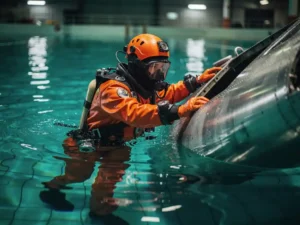
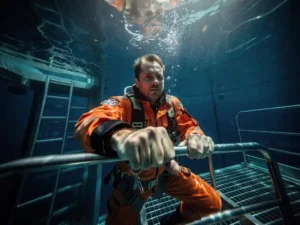
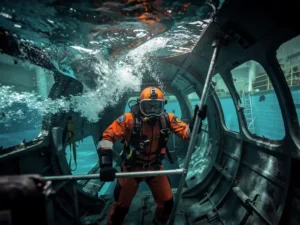
The training is highly practical. Much of the course takes place in a pool environment where participants physically practice escape techniques and survival skills under controlled conditions. This hands-on approach is what makes BOSIET one of the most recognized and respected certifications in the offshore industry.
T-BOSIET covers the same core competencies as BOSIET but is adapted for tropical offshore environments. The key difference in content is that T-BOSIET replaces or adjusts certain elements to reflect the specific hazards of working in warm-water regions, most notably the risk of heat stress and the reduced survival time considerations that apply in tropical conditions.
In tropical waters, the immediate cold-shock risk that dominates temperate survival training is less of a concern. Instead, T-BOSIET places greater emphasis on heat-related illness, sun exposure risks, and the physiological challenges of working in high-temperature environments both on and offshore.
The HUET and sea survival components are still included, as helicopter emergencies and man-overboard scenarios remain relevant regardless of water temperature. However, the survival strategies, protective equipment guidance, and environmental awareness sections are tailored to tropical conditions. If your work takes you to a tropical offshore region, T-BOSIET ensures your training reflects the actual environment you will face.
No, BOSIET and T-BOSIET lead to separate OPITO-accredited certificates. Each certificate is specific to the environment it covers. A BOSIET certificate does not qualify you to work in a tropical offshore region, and a T-BOSIET certificate is not a direct substitute for BOSIET in temperate environments. Operators and contractors check which certificate is required for a specific location, and the wrong certificate will not be accepted.
Both certificates are issued under the OPITO framework, which is the globally recognized standard for offshore safety training. This means both are respected and accepted by operators worldwide, but only within the environmental scope they were designed for.
Both BOSIET and T-BOSIET typically take around three to four days to complete. The exact duration can vary slightly depending on the training provider and the specific course variant, but the structure and volume of practical content are broadly comparable across both courses.
The time commitment reflects the depth of the training. Because both courses involve significant pool-based practical sessions, including helicopter escape simulations and sea survival exercises, they cannot be compressed into a single day. Plan for at least three full days when scheduling your training around a project start date.
Some providers also offer an e-BOSIET variant, which combines online pre-learning with a shorter on-site practical component. This can reduce the time spent at the training center, though the practical elements remain mandatory.
A BOSIET certificate is valid for four years. After that, it cannot simply be renewed with a short refresher. Instead, certificate holders must complete a FOET (Further Offshore Emergency Training) course, which is the designated renewal pathway for both BOSIET and T-BOSIET. FOET also carries a four-year validity period, meaning offshore professionals on a regular renewal cycle will alternate between their initial certification and FOET.
It is important not to let your certificate lapse. An expired BOSIET or T-BOSIET certificate means you are no longer cleared to travel offshore, which can cause serious delays to your project or employment. Most operators will not allow workers on site without a valid certificate, so tracking your expiry date and booking your renewal in advance is essential.
If your T-BOSIET certificate expires, you renew it with a T-FOET course, the tropical equivalent of FOET, which follows the same renewal logic and validity period.
We offer both BOSIET and T-BOSIET as OPITO-accredited courses, with training centers located near major offshore industry hubs, ports, and airports to make scheduling as straightforward as possible. Whether you are an individual professional booking ahead of a project or an organization coordinating training for a team, we make the process clear and reliable.
Here is what you can expect when you book with us:
Ready to book your BOSIET or T-BOSIET course? Visit our T-BOSIET course page to check upcoming dates and secure your place.