

 Hotel and
 Medical checks available at checkout
5 Oct 2026
HUET stands for Helicopter Underwater Escape Training. It is a mandatory safety course that teaches offshore workers how to escape from a helicopter if it ditches into the water, which is one of the most serious risks associated with helicopter travel to offshore installations. The sections below cover everything you need to know about HUET, from who needs it to where you can complete the course.
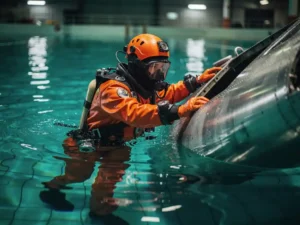
HUET training teaches participants how to safely escape from a submerged or capsizing helicopter. The course combines theoretical instruction with hands-on practical exercises in a controlled pool environment, using a helicopter fuselage simulator that replicates real emergency conditions, including full inversion underwater.
During the practical exercises, participants practice releasing their seatbelt, locating and operating emergency exits, and exiting the simulator both in an upright position and after a full capsize. Breathing and orientation techniques are also covered, so participants know how to stay calm and act effectively in a disorienting situation.
Most HUET courses are delivered under the OPITO standard, which is the internationally recognized accreditation body for offshore safety training. The training typically includes:
HUET certification is required for anyone who travels by helicopter to or from an offshore installation. This includes offshore oil and gas workers, wind energy technicians working on offshore turbines, marine crew, contractors, and any other personnel who board a helicopter as part of their work duties.
Operators and employers are responsible for ensuring all personnel hold a valid HUET certificate before they fly. Many project sites and installation operators will not allow anyone on board a helicopter without proof of valid certification, so completing the course before a project begins is essential to avoid delays.
A HUET certificate is valid for four years from the date of completion. After this period, the certificate expires and must be renewed through a refresher course before the holder can continue traveling by helicopter to offshore locations.
The renewal course for HUET is called FOET, which stands for Further Offshore Emergency Training. FOET is a shorter course designed for professionals who have already completed their initial training and need to keep their certification current. Staying on top of renewal dates is important, as an expired certificate can prevent you from boarding a helicopter and delay the start of a project.
HUET is a standalone underwater escape module, while BOSIET (Basic Offshore Safety Induction and Emergency Training) is a comprehensive offshore safety course that includes HUET as one of its components. If you need full offshore induction certification, BOSIET covers a broader range of skills in a single course.
BOSIET includes helicopter underwater escape training alongside additional modules such as sea survival, firefighting, first aid, and the use of self-rescue breathing apparatus. Workers who are new to the offshore industry typically complete BOSIET as their entry-level qualification, since it satisfies multiple safety requirements at once.
HUET as a standalone course is generally taken by professionals who already hold other offshore safety certifications but specifically need to add or renew their helicopter escape qualification. If you are unsure which course applies to your situation, you can explore the full range of HUET, FOET and BOSIET courses to compare your options, or check the OPITO BOSIET course details directly.
HUET courses are available at OPITO-accredited training centers located near major offshore industry hubs, ports, and airports. Choosing a training center close to your departure point or project location makes it easier to complete the course before traveling to a work site.
When selecting a provider, look for the following:
Training centers with pool facilities that include a helicopter fuselage simulator are required for the practical component, so always confirm that the provider you choose has the necessary equipment on site.
We at FMTC Safety offer OPITO-accredited HUET courses at strategically located training centers, making it straightforward for offshore professionals to get certified before heading to a project. Whether you are booking for yourself or coordinating training for a team, we are here to make the process as smooth as possible.
Here is what you can expect when you book your HUET training with us:
Ready to get certified? View our OPITO HUET course and book your place today, or get in touch if you have questions about which course is right for you.