

 Hotel and
 Medical checks available at checkout
15 Sep 2026
FOET practical exercises cover a range of hands-on emergency response skills designed to refresh and assess your ability to react safely in offshore emergencies. The exercises include helicopter underwater escape training (HUET), sea survival techniques, firefighting, first aid, and emergency communication. FOET is the renewal course for professionals who have already completed BOSIET and need to recertify every four years.
Each practical exercise is assessed against OPITO standards, ensuring your skills remain sharp and your certification stays valid for continued offshore work. This article walks through every key question about what to expect during FOET practical training.
During FOET practical exercises, assessors evaluate your ability to perform emergency response actions under realistic conditions. The core skills assessed include helicopter underwater escape, sea survival, firefighting, first aid, and the use of emergency equipment such as life rafts, survival suits, and breathing apparatus. You must demonstrate competence, not just knowledge.
The OPITO FOET standard requires participants to actively perform these skills rather than simply observe or answer questions. Assessors look for correct technique, calm decision-making under pressure, and the ability to work as part of a team during simulated emergencies. Because FOET is a refresher course, the bar is set at a level that assumes prior experience from your original BOSIET training.
The assessed areas typically include:
FOET differs from BOSIET in scope and depth. BOSIET is the initial certification course, covering all offshore emergency skills from scratch over a longer training period. FOET is the four-year renewal, so it focuses on refreshing and reassessing the same core competencies rather than teaching them for the first time. The practical exercises are similar, but FOET assumes you already have the foundational knowledge.
In practice, this means FOET is shorter and more focused. Instructors spend less time on theory and move more quickly into practical scenarios. The expectation is that participants can perform the required skills with guidance rather than needing step-by-step instruction. If you completed OPITO BOSIET training previously, you will recognize the structure of the exercises, which helps reduce anxiety and lets you concentrate on demonstrating your skills confidently.
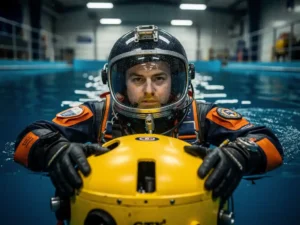
During the HUET exercise in FOET, participants enter a helicopter underwater escape trainer, a simulator that replicates a helicopter cabin. The simulator is submerged and inverted, requiring you to locate the exit, release your harness, and escape underwater. In some versions of the course, this exercise is also performed using an emergency breathing system (EBS) to simulate escape in dark or murky water conditions.
The HUET exercise is one of the most physically and mentally demanding parts of the course. Instructors brief participants thoroughly before the exercise, and safety divers are always present in the water. The goal is to build muscle memory so that in a real emergency, the escape sequence becomes instinctive rather than something you have to think through under stress.
FOET participants complete the HUET exercise with and without the use of an EBS, depending on the specific course variant booked. You can find more detail about the available options on the OPITO HUET and FOET courses page.
The sea survival practical in FOET involves entering the water, donning or confirming the correct use of a survival suit, and boarding a life raft as part of a group. You will practice signaling techniques, maintaining body heat in the water, and supporting other survivors. The exercise takes place in a controlled pool environment designed to simulate open sea conditions.
Sea survival training reinforces the actions you would take after abandoning an offshore installation or surviving a helicopter ditching. Key elements include:
The practical is designed to be realistic enough to build genuine confidence without being unnecessarily dangerous. Instructors and lifeguards supervise the exercise throughout, and participants are briefed on what to expect before entering the water.
FOET is required for any offshore worker who has previously completed BOSIET and needs to renew their OPITO certification. This includes personnel working on oil and gas platforms, offshore wind installations, and other offshore structures where OPITO certification is a mandatory requirement. FOET must be completed every four years to keep your offshore emergency training certificate valid.
If your BOSIET certificate has expired by more than a certain period, you may be required to retake the full BOSIET course rather than the shorter FOET renewal. It is important to track your certificate expiry date and book your FOET course in advance to avoid disruption to your work schedule or project deployment.
On FOET training day, you should bring valid photo identification, your existing offshore training certificates, and any medical clearance documentation required by the training center. Wear comfortable clothing you do not mind getting wet, as the sea survival and HUET exercises involve full water immersion. Swimwear worn under your clothes is recommended.
Here is what to expect on the day:
Arrive rested and well-hydrated. The physical exercises are manageable for most healthy adults, but the combination of water immersion and mental focus can be tiring. Instructors are experienced at supporting participants through any nerves, particularly around the HUET exercise.
We understand that offshore professionals need reliable, flexible training options that fit around project deadlines and travel schedules. That is why we offer FOET courses at strategically located training centers, often near airports and industry hubs, so you can complete your renewal without unnecessary detours.
When you book your FOET course with us, you can expect:
Whether you are booking for yourself or coordinating renewals for a team, we make the process straightforward. Book your OPITO FOET course today and keep your offshore certification current.