

 Hotel and
 Medical checks available at checkout
24 Oct 2026
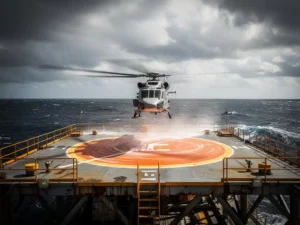
A helideck is a designated helicopter landing platform installed on an offshore installation, such as an oil and gas platform, wind farm service vessel, or floating production unit. It serves as the primary point of access for personnel and supplies traveling between shore and the installation. Understanding how helidecks work is essential for anyone operating in the offshore sector.
A helideck on an offshore platform is typically positioned at the highest accessible point of the structure, most often at one end of the platform deck. This elevated placement keeps the landing area clear of obstacles such as cranes, drilling derricks, and exhaust stacks, giving approaching helicopters an unobstructed flight path.
The exact location varies depending on the type of installation. On fixed platforms, the helideck is usually cantilevered out over the side of the structure to maximize approach angles. On floating production units and semi-submersibles, it is positioned to minimize the effects of vessel movement. In all cases, the helideck must be accessible from the main accommodation block without requiring personnel to cross hazardous work areas.
An offshore helideck is used primarily to transport personnel to and from the installation safely and efficiently. Helicopters are often the fastest and most practical means of crew transfer when a platform is located far from shore, making the helideck one of the most critical infrastructure elements on any offshore facility.
Beyond routine crew changes, helidecks support several other essential operations:
An offshore helideck consists of several structural and safety components that work together to enable safe helicopter operations. The landing surface itself is a reinforced, non-slip deck capable of supporting the full weight of the heaviest helicopter expected to use it, with a clearly marked touchdown and positioning circle (TDP) at its center.
Beyond the landing surface, the main components include:
A helicopter lands safely on an offshore helideck through a combination of precise piloting, standardized approach procedures, and coordination with the platform’s helideck crew. The pilot follows a defined approach path, typically into the wind, and maintains radio contact with the installation throughout the descent.
On the platform side, the helideck landing officer (HLO) plays a central role. The HLO monitors weather conditions, confirms the deck is clear of personnel and obstructions, and gives the pilot permission to land. During the approach, the helideck crew stands by with firefighting equipment ready for immediate deployment. Once the aircraft touches down, the crew secures the helicopter and assists passengers in disembarking safely.
Offshore helicopter landings are more demanding than onshore operations due to the confined deck size, the movement of floating installations, and the proximity of exhaust gases and turbulence from platform structures. Pilots operating in these environments hold specific offshore helicopter pilot qualifications, and helideck crew members are trained to strict international standards.
Offshore helidecks are governed by a combination of international aviation standards, national regulations, and industry guidelines. The primary international framework comes from the International Civil Aviation Organization (ICAO), which sets baseline requirements for helideck design, markings, and operations. These are supplemented by regional regulators such as the Civil Aviation Authority (CAA) in the UK and the European Union Aviation Safety Agency (EASA) in Europe.
In the oil and gas sector, the Energy Institute’s Guidelines for the Management of Offshore Helideck Operations are widely used as the operational standard. This document covers helideck design, crew competency, firefighting capability, and emergency procedures. Operators in the North Sea and other major offshore regions are expected to comply with these guidelines as a minimum.
Helideck inspections are carried out regularly to verify that the structure, firefighting systems, lighting, and markings meet current requirements. Any deficiency that could affect safe operations must be rectified before the helideck is returned to service.
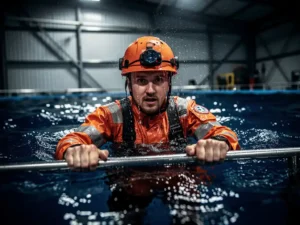
Anyone working on or near an offshore helideck must hold recognized safety training qualifications before they are permitted on the installation. The most fundamental requirement is basic offshore survival training, which covers helicopter underwater escape, sea survival, firefighting, and first aid. This training is mandatory for all offshore personnel, regardless of their specific role.
For personnel with direct helideck responsibilities, additional specialist training is required. The Helideck Landing Officer (HLO) course, accredited by OPITO, qualifies individuals to supervise helicopter operations on the deck. The Helideck Emergency Response Team Operator (HERTO) course trains crew members to respond to aircraft emergencies, including firefighting and casualty handling. Both qualifications have defined renewal periods to ensure competency stays current.
Professionals working in the offshore sector can explore the full range of OPITO helideck courses to understand which qualification applies to their role. For those who need foundational offshore safety certification, HUET and BOSIET training covers the helicopter escape and survival skills required before traveling offshore for the first time.
We at FMTC Safety offer a comprehensive range of OPITO-accredited offshore courses designed to meet the mandatory requirements for anyone working on or around offshore helidecks. Whether you are booking training for yourself or coordinating certification for a team, we make the process straightforward and reliable.
Here is what working with us looks like in practice:
If you need to book offshore helideck training or want to find out which course is right for your role, visit our OPITO offshore courses page to see available dates and locations.