

 Hotel and
 Medical checks available at checkout

13 Oct 2026
Offshore helideck safety requirements cover the physical design of the landing area, the qualifications of the crew managing it, and the operational procedures followed before every flight. These requirements are set by international standards bodies and enforced by national regulators, with the goal of making helicopter transfers to and from offshore installations as safe as possible. The sections below answer the most common questions about what those requirements actually involve.
The installation operator holds overall responsibility for helideck safety offshore. In practice, this means the operator must appoint a qualified Helideck Landing Officer (HLO) who takes direct charge of all helicopter operations on the installation. The HLO is the primary point of contact between the installation and the incoming aircraft, and no landing can proceed without their authorisation.
The helicopter operator also carries a share of responsibility. The pilot in command retains final authority over whether to land, and both parties must communicate clearly before and during every approach. On larger installations, a Helideck Assistant (HDA) supports the HLO during operations, handling firefighting equipment, marshalling and passenger management.
Offshore helideck operations are governed by a combination of international standards and national regulations. The two most widely referenced frameworks are the ICAO Annex 14 Volume II, which sets global standards for heliport design and operations, and the CAP 437 guidance published by the UK Civil Aviation Authority, which is widely adopted across the North Sea and beyond, even outside UK jurisdiction.
Regional regulators add their own layer of requirements. In the UK, the Civil Aviation Authority and the Health and Safety Executive both have oversight roles. In Norway, the Civil Aviation Authority Norway applies its own rules aligned with European standards. In the Gulf of Mexico, the FAA and BSEE set the applicable framework. Most operators also follow guidelines published by the Oil and Gas UK (now NSTA-aligned) and helicopter operators’ associations to ensure consistent practice across the industry.
A compliant offshore helideck must meet strict physical specifications covering size, load capacity, surface condition, markings, lighting and obstacle clearance. The deck must be large enough to accommodate the largest helicopter type expected to use it, with a defined Final Approach and Take-Off (FATO) area free from obstructions. The surface must provide adequate friction to prevent sliding, and drainage must be effective to avoid pooling water or ice build-up.
Regular inspections are required to confirm that all physical features remain in the correct condition. Any defect that affects safety must be reported and rectified before flight operations resume.
Helideck crew must hold OPITO-accredited certifications specific to their role. The Helideck Landing Officer must complete the OPITO HLO Initial course, which covers helicopter operations, communications, emergency procedures and firefighting. The Helideck Assistant must complete the OPITO HDA Initial course. Both certifications require periodic refresher training to remain valid.
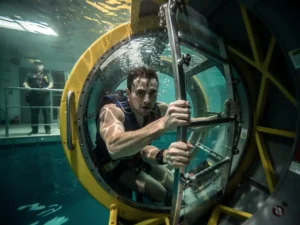
In addition to role-specific helideck training, all crew working on offshore installations are typically required to hold broader offshore survival certifications. These include helicopter underwater escape training and basic offshore safety induction. You can find the full range of OPITO helideck courses that cover both initial and refresher requirements for HLOs and HDAs.
Helideck crew must also be medically fit for offshore work and familiar with the specific installation’s emergency response plan. Practical drills are carried out regularly to ensure the team can respond effectively to a helicopter incident.
Before a helicopter can land on an offshore installation, a structured pre-landing checklist must be completed by the HLO and confirmed with the pilot. These checks verify that the deck is clear, equipment is ready and conditions are within safe operating limits.
If any check fails or conditions deteriorate during the approach, the HLO has the authority to withdraw clearance. The pilot retains the right to abort the landing at any point.
The most common helideck safety hazards offshore are adverse weather, deck contamination, foreign object debris (FOD), communication failures and inadequate crew response during emergencies. Understanding these hazards helps operators put the right controls in place and ensures that crew training addresses the scenarios most likely to cause incidents.
Adverse weather is the leading operational hazard. High winds, reduced visibility, rain, snow and ice can all push conditions beyond safe operating limits. Wind shear and turbulence near offshore structures are particularly challenging because the installation itself disrupts airflow in unpredictable ways.
Deck contamination from fuel spills, hydraulic fluid, seawater or ice reduces surface friction and creates a slip risk for both crew and the helicopter itself. Routine cleaning and surface inspection before each operation are essential controls.
Foreign object debris on the deck poses a serious risk of engine ingestion or rotor strike. Even small items left on the deck can cause catastrophic damage. Pre-landing deck walks are the primary defence against FOD.
Communication failures between the HLO and the pilot can lead to misaligned expectations about landing clearance, deck status or emergency procedures. Maintaining clear, standardised radio protocols reduces this risk significantly.
Inadequate emergency response is a hazard that becomes visible only when something goes wrong. Crew who are unfamiliar with firefighting equipment, emergency shutdown procedures or casualty handling will be slower and less effective in a real incident. This is why OPITO firefighting training and regular drills are a non-negotiable part of helideck crew preparation.
Meeting helideck safety requirements starts with making sure the right people hold the right certifications. We provide OPITO-accredited training for everyone involved in offshore helicopter operations, from HLOs and HDAs to the broader offshore workforce that travels by helicopter to and from installations.
Here is what working with us looks like in practice:
Whether you are an individual preparing for an HLO role or a training coordinator managing certifications across a team, we make the process straightforward. Browse our full range of OPITO offshore courses to find the right training for your situation, or get in touch with our team to discuss your requirements.