

 Hotel and
 Medical checks available at checkout

10 Oct 2026
HOBAS and HUET are two different OPITO-certified helicopter safety courses, but they are not the same. HOBAS (Helicopter Operations Basic Safety) focuses on helideck operations and working safely around helicopters on offshore installations, while HUET (Helicopter Underwater Escape Training) trains you to escape from a helicopter that has ditched into water. The right course for you depends on your specific role and where you work offshore.
Both certifications are widely required in the offshore oil and gas industry, and understanding which one applies to your situation can save you time, money and last-minute stress before a project. Below, we break down the key differences and answer the most common questions professionals have about these two courses.
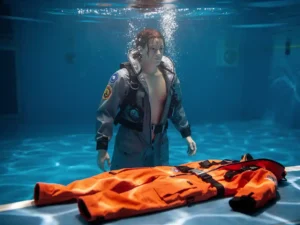
HOBAS training prepares you to work safely in and around helicopter landing areas on offshore platforms. It covers helideck safety rules, emergency procedures, firefighting on the helideck, and how to assist during helicopter operations. HUET training, by contrast, focuses entirely on underwater escape: what to do if a helicopter ditches into the sea, how to brace for impact, and how to exit a submerged, possibly inverted, helicopter cabin.
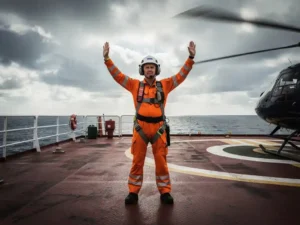
In practical terms, HOBAS is designed for helideck crew and emergency response team members who have an active role in helicopter operations on the installation. HUET is aimed at passengers who travel by helicopter to and from offshore locations and need to know how to survive a water ditching scenario. The physical training exercises are quite different: HUET involves simulated helicopter submersion in a pool, while HOBAS focuses on helideck drills and firefighting.
HOBAS training is required for personnel who work directly on or around the helideck of an offshore installation. This typically includes helideck assistants, helideck crew, emergency response team members with helideck duties, and other offshore workers assigned to helicopter operations support roles.
The course is not a general travel requirement. If your job does not involve active helideck duties, you are unlikely to need HOBAS. Operators and contractors in the oil and gas sector will specify HOBAS as a mandatory requirement in their competency frameworks when the role demands it. If you are unsure whether your role requires it, check your project’s competency requirements or consult your employer’s QHSE team. You can also explore the full range of OPITO helideck courses to understand what falls under this category.
HUET training is required for anyone who travels by helicopter to or from offshore installations, including oil platforms, wind farms, and other offshore structures. This covers offshore workers, engineers, technicians, supervisors, and any visitor who boards a helicopter as a passenger for offshore travel.
HUET is one of the most widely required offshore safety certifications globally. It is a core component of the BOSIET (Basic Offshore Safety Induction and Emergency Training) and FOET (Further Offshore Emergency Training) programmes. Most offshore operators will not allow personnel to travel to their installations without a valid HUET certificate. The specific HUET variant required (with or without a Compressed Air Emergency Breathing System, known as CA-EBS) depends on the operator and the region you are working in. You can find the specific OPITO HUET with CA-EBS course details to see what the training involves.
HOBAS and HUET are separate OPITO-certified courses with different learning objectives, and they are not combined into a single qualification. However, it is entirely possible to complete both certifications, and some offshore professionals are required to hold both depending on their role.
For example, a helideck assistant who also travels by helicopter to offshore locations would need both HOBAS (for their operational helideck role) and a valid HUET certificate (for helicopter passenger safety). In practice, these are booked and completed as separate courses, though a training provider may be able to schedule them back to back to minimize time away from work. HUET is also embedded within broader programmes such as BOSIET, so if you have completed a full OPITO HUET, FOET and BOSIET course, your HUET requirement is already covered within that qualification.
Both HOBAS and HUET certificates are valid for four years from the date of completion. After four years, you are required to complete a refresher or renewal course to maintain your certification and remain eligible to work in roles that require it.
Here is a quick summary of the validity rules for both certificates:
It is important to track your certificate expiry dates carefully. Many offshore operators will not accept personnel whose certificates have expired, which can lead to project delays or last-minute scrambles to rebook training. Setting a reminder at least two to three months before expiry gives you enough time to schedule a refresher course without disrupting your work commitments.
Navigating the requirements for HOBAS and HUET training does not have to be complicated. At FMTC Safety, we offer OPITO-certified helicopter safety courses at strategically located training centers, making it straightforward to get certified or renew before your next offshore project.
Here is what we offer to support your offshore helicopter safety training:
Whether you need a first-time HUET certification, a BOSIET that includes HUET, or a FOET renewal, we can help you find the right course and get booked in quickly. View our OPITO HUET course and book your place today.