

 Hotel and
 Medical checks available at checkout

22 Oct 2026
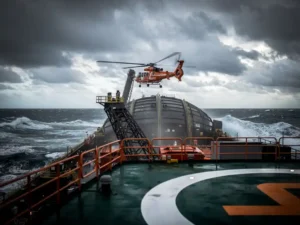
For offshore personnel, helicopter travel is a routine part of the job. It is also one of the most safety-critical parts of the journey. That is why helicopter safety training focuses not only on the flight itself, but also on what to do if an emergency occurs during boarding, transit or a ditching on water.
The OPITO HUET with CA-EBS (5295) course is designed for offshore workers who will be supplied with a Compressed Air Emergency Breathing System (CA-EBS) during helicopter travel. FMTC describes the course as practical training that prepares participants for helicopter emergencies, with a specific focus on underwater escape procedures using CA-EBS.
Helicopter transport to offshore installations places passengers in a confined environment where response time during an emergency is limited. Pre-flight checks, correct seating, brace positions, PPE use and disciplined behaviour during boarding all contribute to safety long before a water impact ever becomes an issue.
HUET training is built around this reality. OPITO states that the product is intended for personnel new to, or returning to, the offshore energy industry who will be provided with a CA-EBS during offshore helicopter travel. The aim is to meet offshore safety and emergency response requirements linked to helicopter transport.
Helicopter safety begins on the helideck or departure point. Boarding procedures are structured to reduce risk, maintain order and ensure that every passenger is ready to respond if the situation changes quickly.
In practice, this means passengers must follow the crew’s directions closely, wear the required personal protective equipment and understand how their seatbelt, exits and emergency equipment work before departure. Good boarding discipline is not just about efficiency. It helps reduce confusion in a high-stress situation and improves the chances of a controlled evacuation if an incident occurs.
Training also reinforces the importance of pre-flight and in-flight awareness. FMTC notes that the course prepares participants to handle both pre-flight and in-flight requirements, especially in a helicopter ditching scenario.
A central part of this training is the Compressed Air Emergency Breathing System. CA-EBS is intended to provide a short-duration emergency air supply during an escape from a ditched helicopter. It is different from rebreather-style EBS systems, and the training reflects those differences.
OPITO describes Dry CA-EBS Initial Deployment Training as training that gives learners knowledge of the hazards and properties of the system, along with the practical emergency response actions required if deployment becomes necessary.
This matters because emergency breathing equipment is only useful if the user understands when to deploy it, how to operate it correctly and how to avoid wasting time or air. In an underwater escape, confusion can be as dangerous as the incident itself. The purpose of the training is therefore not just familiarisation, but confident, correct use under pressure.
The most recognised element of HUET is the simulated underwater escape. This practical part of the training prepares participants for the disorientation that can occur when a helicopter impacts the water, rolls and submerges.
OPITO explains that HUET focuses on the procedures and techniques needed to survive and escape from a helicopter in an emergency, with the core of the training being the practical simulation of a helicopter ditching.
In that scenario, the sequence of actions matters. Passengers must remain oriented, wait for the correct moment to act, release restraints in a controlled way, locate the exit and move out without losing direction. When CA-EBS is part of the equipment provided, participants must also demonstrate that they can deploy and use it in line with the required procedure.
This is why HUET training is heavily practical. It is not enough to understand the theory of escape. Participants need to experience the environment in a controlled setting so that the response becomes more structured and less instinctive in a real event.
Helicopter emergencies are rare, but when they happen, performance depends on practiced behaviour. Training reduces hesitation. It teaches people to rely on procedure instead of panic.
That is also why the offshore sector treats helicopter safety training as a formal requirement rather than general awareness. FMTC’s OPITO category page states that HUET is required for personnel travelling by helicopter to offshore installations and focuses specifically on helicopter safety and escape techniques, including the use of EBS or CA-EBS.
The OPITO HUET with CA-EBS (5295) course is intended for offshore personnel who will be transported by helicopter and issued with a compressed air emergency breathing system. According to FMTC, the course provides the essential knowledge and practical skills to respond effectively during a helicopter emergency, particularly an underwater escape scenario.
The training is recognised across the offshore industry and is designed around realistic emergency response. FMTC also states that successful participants receive an OPITO certificate that is valid for four years.
For anyone travelling offshore by helicopter, understanding boarding procedures, CA-EBS use and underwater escape is a core part of safe operations. The right training helps turn a high-risk scenario into a structured emergency response.
View the OPITO HUET with CA-EBS (5295) course on FMTC Safety for course details, locations and booking options.