

 Hotel and
 Medical checks available at checkout

10 Oct 2026
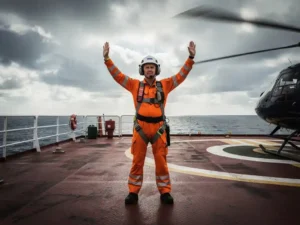
A helideck landing officer (HLO) plays a critical role in managing helicopter operations on offshore installations, and during an emergency, that role becomes one of the most important on the entire platform. The HLO is responsible for coordinating safe evacuation or response on and around the helideck, acting as the primary point of contact between the helicopter crew and the installation’s emergency response team. The sections below break down exactly what that means in practice.
During an emergency, the helideck landing officer takes direct control of the helideck area. This means clearing the landing zone, communicating with the inbound helicopter, signaling the crew, and ensuring that the helideck is safe for either landing or departure. The HLO is the person on deck who makes real-time decisions when conditions or circumstances change rapidly.
In practice, the HLO acts as a bridge between the air crew and the offshore installation. If an emergency evacuation is underway, the HLO manages the flow of personnel to and from the helideck, ensuring that no one boards or disembarks without proper coordination. If the helicopter itself is in distress, the HLO activates the helideck emergency response procedures and alerts the crash fire rescue team immediately.
The HLO emergency role is not reactive. It requires constant situational awareness even before an incident develops, which is why the position demands specific certification and regular refresher training.
An HLO is trained to respond to a range of helideck emergencies, including helicopter fires, crash landings, fuel spills, medical emergencies during embarkation or disembarkation, and full-scale platform evacuations. The training prepares the HLO to act quickly and correctly across all of these scenarios.
The most common scenarios covered in HLO training include:
Each of these situations requires a different response, and the HLO must be able to switch between them depending on what is unfolding. OPITO helideck courses are specifically designed to train HLOs across all of these emergency types in a realistic and structured way.
The HLO coordinates with the emergency response team by serving as the dedicated helideck authority during an incident. While the offshore installation manager or emergency coordinator oversees the broader response, the HLO owns the helideck and communicates directly with the helicopter pilot, the crash fire rescue team, and the control room.
Effective coordination depends on clear communication protocols established before any emergency occurs. The HLO uses radio communication to relay information to the helicopter crew and to receive updates from the control room. Hand signals are used on deck when radio communication is not possible or when the noise environment makes verbal communication unreliable.
During a major emergency such as a full platform evacuation, the HLO works closely with the muster teams to manage passenger flow and ensure that only authorized personnel board the helicopter. This prevents overcrowding, ensures weight limits are respected, and keeps the evacuation orderly under pressure. The HLO also liaises with the major emergency response team to align helideck operations with the broader incident command structure.
During an emergency, the HLO is responsible for the readiness and correct use of all helideck emergency equipment. This includes firefighting equipment, personal protective gear, communication devices, and visual signaling tools. The HLO must know where each item is located and how to deploy it without delay.
Key equipment the HLO manages includes:
Beyond knowing how to use this equipment, the HLO is also responsible for pre-flight and post-flight checks to confirm that everything is in place and operational. During an emergency, there is no time to search for missing equipment, which is why pre-emergency checks are a formal part of the HLO’s responsibilities.
An HLO must hold an OPITO-accredited Helideck Landing Officer certification to legally and safely manage helideck emergencies on offshore installations. This certification is the recognized industry standard and is required across most offshore regions, including the North Sea, the Gulf of Mexico, and international energy projects.
The certification process typically involves the following steps:
The training covers offshore helicopter safety regulations, helideck emergency procedures, firefighting techniques, and communication protocols. Some operators may also require the HLO to hold additional OPITO firefighting certification alongside the core HLO qualification, depending on the installation’s requirements.
Refresher training is not optional. An expired HLO certificate means the holder cannot legally perform the role, which creates a gap in the installation’s emergency response capability.
We offer OPITO-accredited helideck and emergency response training designed for offshore professionals who need to meet certification requirements without disrupting their project schedules. Whether you are booking for yourself or coordinating training for a team, we make the process straightforward.
Here is what you can expect when booking HLO training with us:
If you need to get certified or keep your HLO qualification current, explore our OPITO helideck courses and find the right training for your role and schedule.