

 Hotel and
 Medical checks available at checkout
7 Oct 2026
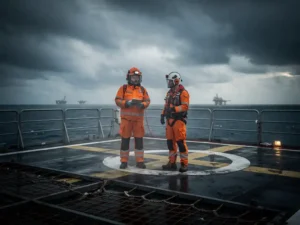
A helideck requires a minimum of three crew members to operate safely: a Helideck Landing Officer (HLO) and at least two Helideck Assistants (HDAs). This minimum applies to standard helicopter operations on offshore installations and is defined by internationally recognized guidelines, primarily those set by the CAA and OPITO. The sections below break down who does what, what training each role requires, and what the consequences are when staffing falls short.
A helideck crew consists of a Helideck Landing Officer and a minimum of two Helideck Assistants. The HLO is the person in charge of all helicopter landing and departure operations on the deck. The HDAs support the HLO by handling firefighting equipment, guiding passengers, securing the aircraft, and managing any emergency response on the helideck.
Each role carries specific responsibilities that cannot be combined or reduced during live operations:
The HLO and HDA roles are not interchangeable. Both must be present and qualified before any helicopter can land or depart from an offshore helideck.
The minimum helideck crew size is governed by the UK Civil Aviation Authority (CAA) publication CAP 437, which is the internationally referenced standard for offshore helideck operations. CAP 437 specifies that a minimum of one HLO and two HDAs must be on station during all helicopter movements. Many national regulators and oil and gas operators adopt CAP 437 as the baseline for their own requirements.
In addition to CAP 437, the OPITO competency framework sets the training and certification standards that determine who is qualified to fill each crew role. Operators in the North Sea, the Gulf of Mexico, and other offshore regions typically reference both CAP 437 and OPITO standards when writing their own helideck operations procedures.
Flag state requirements, operator-specific safety management systems, and client-imposed contract conditions may all raise the minimum above three crew members. The regulatory floor is three, but specific projects or installations often require more based on aircraft size, passenger numbers, or operational risk assessments.
Yes, the required helideck crew size can increase depending on the type of helicopter and the nature of the operation. The three-person minimum applies to standard rotary-wing operations, but larger aircraft, higher passenger loads, or night operations may require additional HDAs to maintain safe coverage across the deck.
Factors that can increase the minimum crew requirement include:
The HLO is always responsible for assessing whether the crew on station is sufficient for the planned operation before clearing any aircraft to land.
Helideck crew members must hold OPITO-accredited certifications specific to their role. The HLO must complete the OPITO Helideck Landing Officer training, and HDAs must complete the OPITO Helideck Assistant course. Both roles also require valid offshore survival and firefighting certifications as a prerequisite.
The core certifications required across a helideck crew typically include:
Certifications must remain current. OPITO certificates have defined validity periods, and crew members with expired certifications cannot legally or safely fill a helideck crew role.
If a helideck is understaffed, operations must be suspended until the minimum crew is in place. Proceeding with fewer than the required number of qualified crew members is a direct violation of CAP 437 and the operator’s own safety management system. The HLO has both the authority and the obligation to halt operations if crew numbers fall below the required minimum.
The practical consequences of understaffing go beyond regulatory non-compliance. With fewer crew on the deck, the response capacity to a helideck fire or crash is significantly reduced. HDAs are the first line of response in the critical seconds after an incident, and a missing crew member means a gap in coverage that cannot be compensated for by experience alone.
For offshore operators, understaffing also carries operational and financial consequences. Helicopter movements may be delayed or cancelled, disrupting crew changes and supply logistics. In a regulatory audit or incident investigation, evidence of understaffed helideck operations can result in enforcement action, suspension of helideck certification, or increased scrutiny of the installation’s broader safety management.
At FMTC Safety, we provide the OPITO-accredited training that helideck crew members need to meet their certification requirements and keep offshore helicopter operations running safely. Whether you are an individual professional working toward your HLO or HDA certification, or an organization coordinating training for an entire crew, we make the process straightforward.
Here is what we offer for helideck and offshore helicopter safety training:
If you need to book helideck crew training or want to check which certifications apply to your role or project, explore our helideck courses and get your crew certified on time.