Hotel and
 Medical checks available at checkout
21 Oct 2026
Helideck operations on FPSOs (Floating Production Storage and Offloading vessels) differ from those on fixed platforms primarily because FPSOs move with the sea. The dynamic motion of a floating vessel introduces additional hazards and complexity that do not exist on a stationary structure. This article unpacks the key differences in structure, regulation, personnel responsibility, and training requirements.
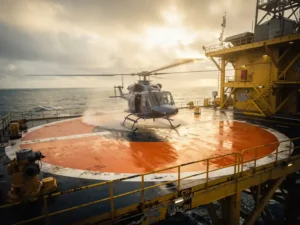
The main structural difference is that an FPSO helideck sits on a vessel that pitches, rolls, and heaves with ocean movement, while a fixed platform helideck is anchored to the seabed and remains essentially stationary. This motion affects deck design, approach angles, pilot technique, and the physical demands placed on helideck personnel during every operation.
Fixed platform helidecks are typically elevated structures mounted on steel jackets or concrete gravity bases. Their position relative to the horizon is predictable, and pilots can rely on consistent reference points during approach and landing. FPSO helidecks, by contrast, are positioned over or near the stern of a vessel and move continuously. Their height above sea level can fluctuate significantly depending on loading conditions, which changes the visual environment for incoming pilots and the working conditions for deck crew.
Additional structural differences include:
FPSO helideck operations are considered more complex because the combination of vessel motion, nearby hazards such as flare booms and process equipment, and variable environmental conditions creates a higher-risk environment than a fixed installation. Personnel must adapt to a moving working surface while maintaining the same standard of safety as on any other offshore helideck.
The motion of the vessel affects nearly every aspect of deck operations. A helideck assistant walking across the deck during a landing must account for unexpected movement underfoot. Refuelling operations, fire response positioning, and aircraft marshalling all require greater situational awareness when the platform beneath you is not stationary.
FPSOs also tend to be located in more remote or deepwater environments, which increases the consequences of any incident. Emergency response times from shore are longer, and the number of personnel available on board to assist in a major emergency may be more limited. These factors raise the stakes for every helicopter movement and reinforce why thorough training and strict procedures are essential for anyone working on an FPSO helideck.
Offshore helideck operations are governed by a combination of international aviation standards, flag state regulations, and industry-specific guidelines. The most widely applied framework in the oil and gas sector is the OPITO offshore training standard, which sets competency requirements for helideck personnel across global operations.
Key regulatory sources include:
For FPSOs specifically, flag state regulations and classification society rules add another layer. Because an FPSO is a vessel, it falls under maritime law as well as aviation regulations, meaning operators must satisfy requirements from multiple regulatory bodies simultaneously.
Helideck personnel working on either FPSOs or fixed platforms are required to hold OPITO-certified helideck training. The core qualifications are the same regardless of installation type, but FPSO operations may require additional awareness of vessel-specific hazards and emergency procedures that go beyond the fixed platform context.
The primary OPITO qualifications for helideck personnel include the Helideck Assistant (HDA) course and the Helideck Emergency Response Team Leader (HERTL) course. Both are internationally recognised and required by most operators before anyone is permitted to work on a helideck in an active capacity.
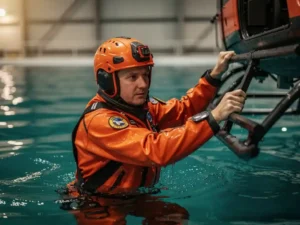
Alongside helideck-specific training, all offshore personnel travelling by helicopter are required to hold a valid HUET or BOSIET certification before boarding an offshore helicopter. This training covers helicopter underwater escape, survival techniques, and emergency procedures in the event of a ditching. On FPSOs, where the helicopter landing environment is more dynamic and the vessel may be further from shore, this survival training is especially relevant.
Personnel transitioning from fixed platform to FPSO helideck roles should also familiarise themselves with:
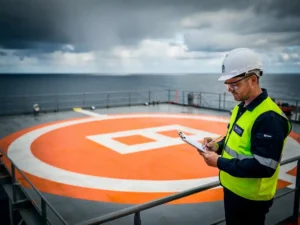
Responsibility for helideck safety on an offshore installation sits with the installation operator, but is delegated operationally to the Offshore Installation Manager (OIM) and the Helideck Landing Officer (HLO). The HLO holds direct authority over all helideck activities and is the primary point of contact between the installation and the helicopter crew.
The HLO is responsible for assessing whether conditions are safe for helicopter operations, communicating weather and deck status to the pilot, supervising helideck assistants, and ensuring all equipment and procedures meet the required standard. On an FPSO, the HLO must also factor in vessel motion, heading relative to wind, and any operational activity on deck that could affect safety.
Supporting the HLO is the helideck team, which typically includes trained helideck assistants who handle marshalling, fire cover, and post-landing checks. On larger FPSOs, this team may also include a dedicated Helideck Emergency Response Team Leader who coordinates emergency response if an incident occurs during helicopter operations.
Ultimately, the operator holds legal accountability for maintaining a safe helideck environment. This includes ensuring all personnel are trained to the required standard, that equipment is maintained and inspected regularly, and that procedures are kept up to date with current regulations.
Whether you work on a fixed platform or an FPSO, having the right certified training in place is essential before you step onto a helideck. We at FMTC Safety offer the full range of OPITO-accredited helideck and offshore safety courses, designed for professionals across the global oil, gas, and energy sectors.
Here is what we offer helideck professionals and their employers:
If you need to book helideck training for yourself or your team, get in touch with us through our contact page and we will help you find the right course and schedule to meet your project requirements.