

 Hotel and
 Medical checks available at checkout
24 Sep 2026
T-FOET, or Tropical Further Offshore Emergency Training, is a refresher course for offshore professionals who work in tropical regions and hold a T-BOSIET certificate. It updates and validates the emergency survival skills required for working in warm-water offshore environments, keeping your certification current and your employer compliant. Below, we answer the most common questions about T-FOET so you know exactly what to expect.
T-FOET is required for offshore workers whose T-BOSIET certificate is approaching its expiry date and who continue to work in tropical offshore environments. This typically includes drilling personnel, maintenance technicians, logistics staff, and other professionals deployed to warm-water regions such as West Africa, Southeast Asia, the Middle East, or South America.
If you originally completed a standard BOSIET for temperate waters and later moved to a tropical project, you would need to check whether your employer or client requires a T-BOSIET and the corresponding T-FOET refresher instead. The tropical variants are specifically designed for environments where sea temperature, climate conditions, and regional operational factors differ significantly from colder offshore zones.
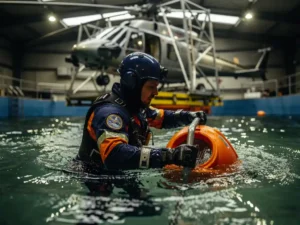
T-FOET training covers the core emergency response and survival skills needed to stay safe in a tropical offshore environment. The course refreshes and updates the knowledge and practical competencies from your original T-BOSIET, ensuring that your skills remain sharp and current.
The training typically includes the following elements:
Because T-FOET is a refresher rather than an introductory course, the pace is more focused, and the content builds directly on what you already know from your T-BOSIET. The practical exercises are a central part of the programme, keeping the training hands-on and realistic.
The key difference between T-FOET and FOET is the environment they are designed for. FOET (Further Offshore Emergency Training) is the standard refresher for temperate or cold-water offshore regions, while T-FOET is the tropical equivalent, intended for warm-water environments. Both are OPITO-accredited refresher courses, but they are not interchangeable.
In practical terms, the content of both courses is similar in structure, but T-FOET includes elements and scenarios specific to tropical conditions. For example, sea survival training accounts for the physiological and environmental differences of warm water, and certain equipment considerations may differ from the temperate version.
Your choice between the two depends entirely on where you work. If your project is in the North Sea or another cold-water region, FOET is the correct course. If you are deployed to a tropical offshore location, T-FOET is what you need. Booking the wrong refresher will not satisfy your employer’s or client’s certification requirements, so it is worth confirming the requirement before you register. You can browse the full range of OPITO HUET, FOET and BOSIET courses to compare the available options.
A T-FOET certificate is valid for four years from the date of issue. This follows the standard OPITO certification cycle for offshore emergency training refreshers. Before your certificate expires, you will need to complete another T-FOET to maintain your eligibility to work in tropical offshore environments.
It is important not to let your certificate lapse. An expired T-FOET means you are no longer compliant with the safety requirements set by operators and clients in tropical regions, which can result in being stood down from a project or delayed in mobilisation. Many professionals and their booking teams set a reminder well in advance of the expiry date to ensure training is completed on time and documentation is ready before the next deployment.
T-FOET training is available at OPITO-accredited tropical training centres around the world. Because the course requires specific pool and practical facilities, not every training location offers it, so it is worth checking availability at a centre close to your project departure point or home base.
When choosing a training centre, look for OPITO accreditation, confirmed course dates, and a location that fits your travel schedule. Many offshore professionals prefer to complete their training near an airport or port before travelling directly to a project, which saves time and reduces the risk of last-minute delays.
At FMTC Safety, we make it straightforward to stay on top of your tropical offshore certification. Whether you are an individual contractor managing your own training schedule or a coordinator booking for a team, we offer practical support at every step.
If you are ready to book or want to check available dates, view our T-FOET course page for full details and upcoming sessions.