

 Hotel and
 Medical checks available at checkout
16 Sep 2026
T-FOET training covers the same core offshore survival and emergency response skills as the original FOET, but delivered in a tropical or hot climate context. It is designed for professionals who work in regions with high ambient temperatures, where standard FOET training does not fully reflect the environmental conditions they will encounter. This article walks through everything you need to know about the T-FOET course, from content and duration to certification validity and where to book.
T-FOET, or Tropical Further Offshore Emergency Training, is the tropical variant of the standard FOET qualification. The key difference is that T-FOET is accredited by OPITO and is specifically designed for offshore workers operating in tropical or high-temperature environments, where heat stress and different sea conditions present additional risks not covered in the standard FOET course.
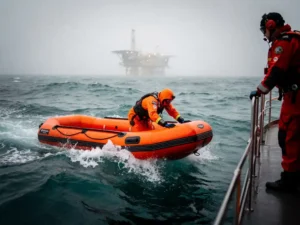
While both courses refresh and build on the foundational survival skills from BOSIET or T-BOSIET, T-FOET incorporates training elements that reflect the physical demands of working in hot climates. This includes awareness of heat-related illness, survival considerations in warm open water, and emergency scenarios relevant to tropical offshore regions such as parts of Southeast Asia, West Africa and the Middle East.
T-FOET training covers a broad range of offshore emergency and survival topics, combining theoretical knowledge with hands-on practical exercises. The course content is standardized by OPITO, ensuring consistent quality across all accredited training providers worldwide.
Typical topics and exercises included in a T-FOET course are:
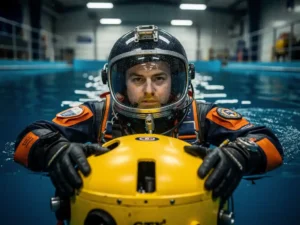
The practical exercises are a central part of the course. Participants work in a pool environment to practice helicopter escape and sea survival scenarios, which makes the training both realistic and physically demanding. Instructors with real offshore experience guide participants through each exercise, keeping the content directly relevant to real-world conditions.
T-FOET training is typically completed over one to two days, depending on the specific course structure offered by the accredited provider. The course combines classroom-based instruction with pool and practical exercises, and the schedule is designed to be intensive but manageable within a short timeframe.
Because T-FOET is a further offshore emergency training course rather than an initial qualification, it assumes participants already hold a valid T-BOSIET or equivalent entry-level certification. This prior knowledge means the course can focus on refreshing and updating skills rather than teaching everything from scratch, which is why the duration is shorter than the initial training.
T-FOET certification is required for offshore workers whose initial tropical offshore safety training, typically T-BOSIET, has expired and who continue to work in tropical offshore environments. It is a mandatory refresher qualification for anyone whose role requires them to travel to or work on offshore installations in tropical regions.
Professionals who typically need a valid T-FOET certificate include:
Operators and employers working under OPITO standards will generally specify which certification is required before a worker can be mobilized to a project. Always confirm with your employer or project operator which exact standard applies to your role and location.
A T-FOET certificate is valid for four years from the date of completion. After this period, the certificate expires and the holder must complete a further T-FOET course to remain compliant and eligible to work on tropical offshore installations that require OPITO certification.
It is strongly recommended to plan your renewal well in advance of the expiry date. Many offshore projects require workers to hold a certificate that is still valid at the time of mobilization, meaning an expired certificate can result in delays or being stood down from a project. Booking your T-FOET renewal course at least a few weeks before expiry gives you a comfortable buffer and avoids disruption to your work schedule.
T-FOET training must be completed at an OPITO-accredited training center. OPITO accreditation guarantees that the course content, instructors and facilities meet the required international standards, and that the certificate issued will be recognized by operators and employers worldwide.
When choosing a training provider, consider the following factors:
We offer OPITO HUET, FOET and BOSIET courses from strategically located training centers, making it straightforward to fit your certification requirements around project timelines.
We are an OPITO-accredited safety training provider with a strong track record in offshore emergency training. Whether you are an individual professional renewing your certificate or an organization coordinating training for a team, we make the process straightforward and reliable.
Here is what you can expect when you book your T-FOET course with us:
Ready to book or want to find out more? View our T-FOET course and secure your place today.