

 Hotel and
 Medical checks available at checkout
21 Sep 2026
BOSIET training includes a set of mandatory practical exercises designed to prepare offshore workers for emergencies at sea. The course combines helicopter underwater escape training (HUET), sea survival drills, and firefighting exercises, all carried out in a controlled environment under the supervision of certified instructors. Below, we break down each exercise and what you can expect from the training.
BOSIET typically involves three core practical exercise modules: helicopter underwater escape training (HUET), sea survival, and firefighting and self-rescue. These hands-on components are combined with classroom-based learning and, in some versions of the course, e-learning modules completed before the practical days begin.
The full BOSIET course is accredited by OPITO, the global safety body for the oil and gas industry. Each practical module is structured around real offshore emergency scenarios, so participants leave with skills they can apply in the field rather than just theoretical knowledge. The number of exercises within each module varies slightly depending on the training provider and course variant, but the three core areas remain consistent across all OPITO-approved BOSIET programs.
During the HUET component of BOSIET, participants practice escaping from a simulated helicopter that has ditched into the water and inverted. Trainees are secured inside a training rig that is lowered into a pool, rotated upside down, and submerged, requiring them to locate and open an exit hatch while underwater. This exercise is repeated multiple times, including in conditions with reduced visibility.
The HUET exercise is widely considered the most intense part of BOSIET training. It is designed to replicate the disorientation and physical challenge of a real helicopter ditching scenario, which is one of the most serious risks faced by offshore workers travelling by helicopter to and from platforms.
Most BOSIET variants include the use of an Emergency Breathing System (EBS) during at least one of the underwater escape exercises. The EBS is a small compressed air device that gives you a brief supply of breathable air underwater, allowing extra time to locate and open the exit. Practicing with this equipment is a key part of the exercise.
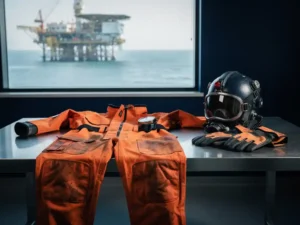
The sea survival exercise in BOSIET trains participants to stay afloat, signal for rescue, and work as a group in open water following an offshore emergency. Participants enter a training pool wearing a survival suit and lifejacket, practice donning the suit correctly, and carry out a range of survival techniques including the HELP position (Heat Escape Lessening Posture) and group huddle formations.
The sea survival module also covers the deployment and boarding of a life raft. Participants practice:
This module reinforces the classroom content on survival at sea and gives participants the physical confidence to act quickly and effectively in a real emergency situation.
The firefighting component of BOSIET covers the use of portable fire extinguishers and introduces participants to fire behavior in an offshore context. Trainees learn how to identify fire classes, select the correct extinguisher, and apply a controlled attack on a small fire. Self-rescue drills focus on escaping a smoke-filled environment using a breathing apparatus or escape hood.
These drills are practical and scenario-based. Participants are guided through:
The firefighting exercises are less physically intense than HUET but require focus and confidence under pressure. They reflect the real conditions workers may encounter on an offshore platform, where fast and correct action can prevent a small incident from escalating.
BOSIET training is physically demanding, particularly the HUET exercise. Participants need to be comfortable in water, able to hold their breath briefly, and capable of operating under physical and psychological stress. The sea survival exercises also require sustained activity in water while wearing a survival suit, which adds resistance and weight.
Most OPITO-approved BOSIET courses require participants to complete a basic fitness declaration or medical questionnaire before attending. This is not a fitness test, but it ensures that participants with relevant health conditions are aware of the physical requirements and can seek medical advice if needed. Anyone with concerns about swimming ability or water confidence should contact their training provider in advance to discuss options or any available support during the exercises.
A BOSIET certificate is valid for four years from the date of completion. After this period, offshore workers are required to complete a FOET (Further Offshore Emergency Training) course to renew their certification and maintain their eligibility to work offshore.
The FOET refresher course revisits the core practical exercises from BOSIET, including HUET and sea survival, to ensure that certified workers maintain their emergency response skills throughout their careers. Keeping track of your certificate expiry date is important because many offshore operators and project managers require valid certification before allowing workers on site. An expired BOSIET can result in delays to mobilization or loss of work opportunities.
At FMTC Safety, we offer OPITO-accredited BOSIET training at multiple locations, delivered by qualified instructors with real offshore experience. Whether you are booking as an individual professional or coordinating training for a team, we make the process straightforward and reliable.
Here is what you can expect when you book with us:
Ready to book your BOSIET training? View our BOSIET course options and find a date and location that works for you.