

 Hotel and
 Medical checks available at checkout
9 Sep 2026
To get your first offshore job, you need to complete the mandatory safety training required for your role and sector, then apply to offshore employers or staffing agencies with your certifications in hand. Most entry-level offshore positions do not require prior offshore experience, but having the right safety certificates is non-negotiable before you set foot on a platform or vessel.
The offshore industry has strict safety requirements, and employers will not hire anyone who lacks the necessary certifications. Understanding which training you need, how long it takes, and where to complete it is the fastest way to make yourself employable.
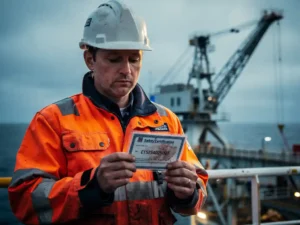
To work offshore, you typically need a combination of role-specific technical qualifications and mandatory safety certifications. The exact requirements depend on your job function, the region where you will work, and the operator running the project. However, safety training is a universal requirement across all offshore roles, regardless of your technical background.
Common qualifications employers look for include:
For entry-level roles such as roustabout, roughneck, or catering assistant, technical qualifications are often less important than your safety certifications and physical fitness. Operators and drilling companies want to know you can work safely in a hazardous environment before anything else.
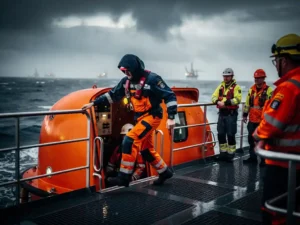
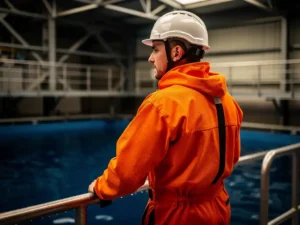
Before working offshore, most professionals are required to complete OPITO-accredited safety training. The most common entry-level course is the BOSIET (Basic Offshore Safety Induction and Emergency Training), which covers survival techniques, firefighting, first aid, and helicopter underwater escape. This certificate is widely recognized across the North Sea and many other global offshore regions.
Depending on where you will work, you may also need:
You can explore the full range of OPITO basic offshore courses to understand exactly which certificates apply to your situation before you book.
No, you do not need prior offshore experience to land your first offshore job. Many entry-level positions are specifically designed for people who are new to the industry. What matters most to employers at this stage is that you hold the required safety certifications, pass an offshore medical, and demonstrate a willingness to work in a demanding environment.
Roles like roustabout, galley hand, and general assistant are common starting points for people with no offshore background. From there, most workers build experience and progress into more specialized technical or supervisory roles over time. The offshore career path rewards people who show up certified, reliable, and safety-conscious from day one.
The most effective way to find offshore job vacancies as a beginner is to register with offshore-focused staffing agencies and apply directly to drilling contractors and service companies. These are the organizations that hire at entry level, and they actively recruit candidates who already hold their safety certifications.
Having your BOSIET or OPITO certification already completed gives you a significant advantage over other applicants, because employers can place you on a project without waiting for you to finish your mandatory training.
Getting certified for offshore work typically takes between three and five days for the core safety training. The BOSIET course, which is the most common entry-level requirement, runs over approximately three to four days and covers all the essential emergency and survival skills you need before going offshore for the first time.
If you also need a HUET certificate and an offshore medical, you can usually complete both within the same week as your BOSIET training. This means that from the moment you decide to pursue an offshore career, you could be fully certified and ready to apply within one to two weeks, depending on course availability and scheduling.
Offshore safety training is available at accredited training centers around the world. When choosing a provider, look for OPITO-accredited facilities located near major ports, airports, or industry hubs, so you can complete your training conveniently before traveling to your project location.
We have training centers in the Netherlands, the United States, France, Belgium, Saudi Arabia, and other strategic locations, all chosen specifically to make access as straightforward as possible for offshore professionals. You can check our training center locations to find the facility closest to you.
Starting an offshore career means getting the right certifications quickly, reliably, and without unnecessary complications. That is exactly what we focus on at FMTC Safety.
Here is what you can expect when you train with us:
Whether you are booking your very first BOSIET or refreshing an existing certificate before a new project, we make the process clear and straightforward. Browse our offshore safety courses and take the first step toward your offshore career today.