

 Hotel and
 Medical checks available at checkout
3 Sep 2026
Yes, you can take HUET training without being able to swim. OPITO standards require participants to demonstrate a basic level of water competency, but this does not mean you need to be a confident swimmer. Most people with limited swimming ability are able to complete the training successfully with the right preparation and support from qualified instructors.
The water competency element is designed to assess whether you can stay calm and follow safety procedures in the water, not to test your swimming technique. Below, we answer the most common questions about HUET swimming requirements so you know exactly what to expect before you arrive.
You do not need to be a strong swimmer to take HUET training. OPITO guidelines require participants to complete a basic water competency assessment, which involves floating and moving a short distance in a pool. This is not a swimming test in the traditional sense, and many participants with limited swimming experience pass it without difficulty.
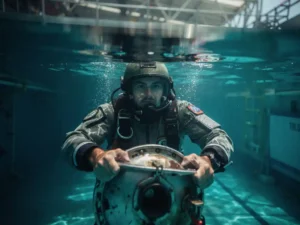
The purpose of HUET, or helicopter underwater escape training, is to prepare offshore workers for the specific scenario of escaping a submerged or inverted helicopter. The skills involved, such as controlled breathing, releasing seatbelts underwater, and locating exits, rely on composure and technique rather than swimming ability. Participants wear personal flotation equipment during most exercises, which significantly reduces the physical demand placed on them in the water.
The water competency assessment in HUET training typically requires participants to jump into a pool, float unaided for a short period, and swim a set distance, usually around 25 metres. The assessment is conducted in a controlled pool environment with trained instructors present at all times.
Once the water competency check is completed, participants move on to the main practical exercises, which include:
These exercises are carried out step by step, and instructors guide participants through each stage before asking them to perform it independently. The environment is safe, structured, and designed to build confidence progressively.
If you struggle during any part of the water exercises, instructors will provide additional support and guidance. HUET training is not a pass-or-fail race. Instructors are trained to recognise when a participant needs more time, reassurance, or a modified approach, and they will work with you to help you complete the required exercises safely.
In some cases, participants who experience significant difficulty with the water competency assessment may be asked to repeat a section or may not be able to complete the full certification on that day. However, this is relatively uncommon. The training environment is deliberately calm and supportive, and instructors are experienced in helping anxious or less confident participants work through the exercises at a manageable pace.
If you have concerns about your water confidence before the course, it is always a good idea to contact the training provider in advance. Being open about any anxiety allows instructors to prepare and offer additional guidance from the start of the session.
Yes, certain medical or physical conditions can prevent someone from participating in HUET training. Because the course involves submersion in water, breath-holding, and physical activity in a confined space, participants must meet specific medical fitness standards before they can take part.
Conditions that may affect eligibility include:
Participants are typically required to complete a medical self-declaration before the course. In some cases, a formal offshore medical certificate, such as an OGUK or equivalent medical, may also be required depending on the certification pathway you are following. If you are unsure whether a condition affects your eligibility, consult your doctor and speak with the training provider before booking.
Non-swimmers or people with low water confidence can prepare for HUET training by spending time in a pool before the course. You do not need to learn to swim properly, but getting comfortable in the water, practising floating, and becoming familiar with the sensation of being submerged will make the training day significantly easier.
Here are practical steps to help you prepare:
Mental preparation is just as important as physical readiness. Understanding that the exercises are conducted in a safe, supervised pool environment and that instructors are there to support you can make a significant difference to how you experience the day. Many participants who were anxious beforehand describe the training as manageable and even confidence-building once they complete it.
For more information about what to expect, you can explore our HUET and BOSIET course options to review the full course content before you book.
At FMTC Safety, we understand that HUET training can feel daunting, especially if you are not a confident swimmer. Our goal is to make sure every participant arrives informed, supported, and ready to complete their certification successfully.
Here is what we offer to make your HUET experience as smooth as possible:
Whether you are booking as an individual offshore worker or coordinating training for a team, we are here to help you meet your certification requirements with confidence. View our OPITO HUET course and book your place today, or get in touch with our team if you have questions before you sign up.