Hotel oraz
 Medyczny czeki dostępne przy kasie
12 Nov 2026
The helideck firefighting procedure on an offshore platform is a structured emergency response that activates the moment a fire or crash is detected on or near the helideck. A dedicated helideck emergency response team deploys immediately, using specialized foam and dry powder equipment to suppress the fire, protect any occupants, and prevent the emergency from spreading to the rest of the installation. This procedure is governed by international standards and must be rehearsed regularly by all personnel assigned to helideck duties. The sections below break down the key roles, equipment, differences from other offshore fire emergencies, required training, and the most common causes of helideck fires.
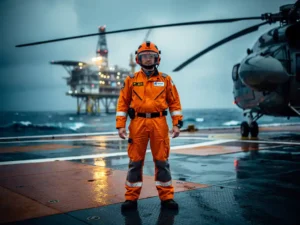
A helideck firefighting response involves a dedicated team of trained personnel, each with a clearly defined role. The core of this team is the Helideck Emergency Response Team (HERT), which typically includes a Helideck Landing Officer (HLO), Helideck Assistants (HDAs), and firefighting crew members. Each member has specific duties that are activated the moment an emergency is declared on the helideck.
The HLO carries overall responsibility for helideck operations and acts as the primary coordinator during an emergency. The HDAs support the HLO by deploying equipment, assisting evacuees, and maintaining communication with the installation’s main emergency control center. Firefighting crew members handle the physical suppression of flames using foam and powder agents.
Depending on the size and type of the installation, additional support roles may include:
Clear role assignment and regular drills are essential. In a real helideck emergency, there is very little time to make decisions, so every team member must know exactly what to do before the alarm sounds.
Helideck firefighting equipment is purpose-built to handle aviation fuel fires, which behave very differently from standard hydrocarbon or electrical fires. The primary agent used is aqueous film-forming foam (AFFF) or fluorine-free foam alternatives, which rapidly suppress jet fuel fires by forming a smothering layer over the burning surface. Dry powder extinguishers are used as a secondary agent for rapid knockdown.
Standard helideck firefighting equipment typically includes:
All equipment must be stored in designated positions around the helideck perimeter, kept in serviceable condition, and inspected on a regular schedule. Equipment that is not immediately accessible or properly maintained can compromise the entire response when seconds matter.
A helideck fire response differs from other offshore fire emergencies primarily because it involves aviation fuel, a live or recently landed aircraft, and potentially trapped passengers who need rapid rescue. The combination of these factors demands a faster initial response, different suppression agents, and a simultaneous focus on both fire suppression and aircraft rescue.
In a standard offshore fire emergency, the primary goal is to contain and extinguish the fire while evacuating personnel from the affected area. On a helideck, the response team must do both at once: suppress the fire while potentially extracting passengers from a damaged helicopter. This dual focus makes the helideck scenario one of the most complex and time-critical emergency situations on an offshore installation.
Other key differences include:
These factors are why helideck emergency response is treated as a distinct discipline with its own dedicated training standards, separate from general OPITO fire fighting courses.
Offshore workers assigned to helideck duties need OPITO-accredited helideck training to legally and competently carry out their roles in a helideck fire emergency. The two primary qualifications are the Helideck Landing Officer (HLO) certification and the Helideck Assistant (HDA) certification, both of which include practical firefighting elements specific to aviation emergencies.
These courses cover foam and dry powder application techniques, aircraft rescue procedures, the use of breathing apparatus in a helideck environment, and coordination within the HERT structure. Training is hands-on and scenario-based, reflecting the reality that helideck emergencies require muscle memory as much as theoretical knowledge.
Workers who are not part of the dedicated HERT but who work on or near the helideck may also be required to complete awareness-level training so they understand evacuation procedures and do not interfere with the emergency response. For broader offshore safety competency, many workers also hold OPITO basic safety training certifications that include general fire response and emergency procedures.
Certificates must be renewed within the validity period specified by OPITO standards. Letting a helideck certification expire can prevent a worker from being deployed to an installation that requires a staffed HERT.
The most common causes of helideck fires on offshore platforms are fuel leaks during refueling operations, hard landings that rupture fuel tanks, and post-crash fuel ignition from hot engine components. While helideck fires are relatively rare when procedures are followed correctly, the consequences when they do occur can be severe, which is why prevention and preparedness are both critical.
Understanding the root causes helps teams target their risk controls effectively. The most frequently cited contributing factors include:
Most helideck fires that do occur are caught quickly because trained HERT members are present during every helicopter movement. The requirement for the team to be in position before landing and departure is precisely what keeps response times short and outcomes manageable.
Helideck firefighting is a high-stakes discipline that demands certified, practiced personnel on every installation. We at FMTC Safety offer OPITO-accredited helideck training designed to prepare HLOs, HDAs, and supporting crew for exactly the scenarios described in this article.
Oto, jak wygląda współpraca z nami w praktyce:
Whether you are an individual worker renewing your HDA certificate or an HSE coordinator scheduling training for an entire helideck team, we are here to make the process straightforward. Contact us today to find the right helideck course for your role or your team.