Hotel dan
 Perubatan cek tersedia semasa pembayaran
10 Nov 2026
A helideck landing officer (HLO) is the person in charge of all helicopter operations on an offshore installation, while a helideck assistant (HDA) supports those operations under the HLO’s supervision. The two roles are distinct in terms of responsibility, authority, and the level of training required. Understanding the difference matters whether you are planning your own offshore career or coordinating crew certifications for a project.
A helideck landing officer is the person with overall responsibility for the safe operation of the helideck on an offshore installation. The HLO coordinates all helicopter movements, communicates directly with the pilot, manages the helideck team, and ensures that every landing and departure meets strict safety standards set by aviation and offshore authorities.
The HLO holds a supervisory and decision-making role. In practice, this means the HLO is the one who gives the final clearance for a helicopter to land or take off. If conditions are unsafe, the HLO has the authority to halt operations entirely. This level of responsibility requires not only technical knowledge of helideck operations but also strong situational awareness, communication skills, and the ability to manage emergencies calmly and effectively.
The HLO also keeps records of all helicopter movements, checks that the helideck meets the required standards before each operation, and ensures that all personnel on the helideck are properly trained and equipped.
A helideck assistant supports the HLO during helicopter operations on an offshore installation. The HDA carries out practical tasks on the helideck itself, such as marshalling the helicopter, handling baggage and cargo, assisting passengers, and monitoring fire safety equipment during landings and departures.
While the HDA does not hold command authority over the helideck, the role is operationally essential. Without a qualified HDA, many helideck operations simply cannot proceed. The HDA works as part of a coordinated team, following the HLO’s instructions and maintaining safety standards on the deck at all times.
Key responsibilities of a helideck assistant typically include:
The main difference between an HDA and an HLO is one of authority and responsibility. The HLO is the designated person in charge of the helideck and holds legal and operational responsibility for all helicopter movements. The HDA is a trained support role that works under the HLO’s direction and does not hold command authority.
Beyond authority, the roles differ in several important ways:
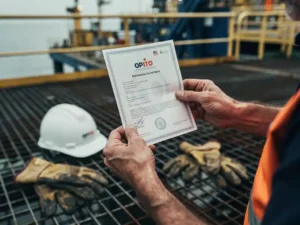
Both the HDA and HLO roles require OPITO-accredited certification, but the courses differ significantly in scope and depth. The HDA course is the entry-level qualification, while the HLO course is a more advanced programme typically requiring candidates to have already completed HDA training and gained practical experience.
The OPITO Helideck Assistant (HDA) course covers the core competencies needed to work safely on a helideck. Topics include helideck familiarisation, firefighting, first aid, communication procedures, and practical on-deck drills.
The OPITO Helideck Landing Officer (HLO) course builds on these foundations and adds supervisory skills, in-depth knowledge of aviation regulations, emergency management, and leadership on the helideck. Candidates must demonstrate a higher level of competence across all aspects of helideck operations.
Both certifications are internationally recognised and required by operators across the North Sea, the Gulf of Mexico, and other major offshore regions. You can find the full range of OPITO helideck courses to see which qualifications apply to your role.
Yes, an HDA can progress to become an HLO, and in most cases this is the expected career path. OPITO guidelines generally require candidates for the HLO course to have completed HDA certification first and to have accumulated a minimum amount of practical helideck experience before enrolling in the HLO programme.
The typical progression looks like this:
This structured progression ensures that HLOs have real-world helideck experience before taking on supervisory responsibility. Rushing straight to the HLO level without hands-on HDA experience would leave significant gaps in practical understanding, which is why the pathway is designed the way it is.
Both certifications require periodic refresher training to remain valid, so staying on top of renewal dates is just as important as the initial qualification. If you work across multiple offshore projects, keeping your certificates current avoids delays when operators check crew documentation before mobilisation. It is also worth checking whether your OPITO offshore courses need to be renewed at the same time, since many certifications run on similar cycles.
Whether you are starting out as an HDA or working towards your HLO certification, finding a reliable and accredited training provider makes a real difference to how smoothly the process goes.
At FMTC Safety, we offer OPITO-accredited helideck training at strategically located training centres, including sites in the Netherlands, the United States, France, Belgium, and Saudi Arabia. Our instructors are experienced offshore professionals who bring practical knowledge into every session, making the training directly relevant to real helideck operations.
Inilah yang anda boleh jangkakan apabila anda berlatih bersama kami:
Ready to book your helideck training or find out which course is right for your role? Contact our team and we will help you get certified efficiently and on time.