Hotel dan
 Perubatan cek tersedia semasa pembayaran
8 Nov 2026
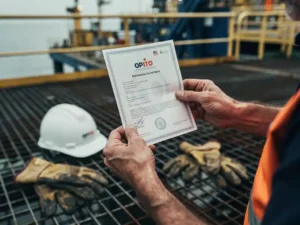
HUET training includes a series of water-based exercises designed to simulate a helicopter ditching at sea. Participants practise escaping from a submerged, inverted helicopter simulator, operating emergency breathing systems, and reaching the surface safely. These exercises are mandatory for anyone who travels by helicopter to offshore oil, gas, or wind installations.
The training is built around realistic, hands-on drills rather than classroom theory. It prepares offshore workers to act quickly and calmly in one of the most disorienting emergency scenarios they could face at sea. Below, we answer the most common questions about what HUET training actually involves.
A HUET exercise takes place in a purpose-built pool facility using a helicopter fuselage simulator. The simulator is lowered into the water, rolls over to replicate an inverted ditching, and participants must locate their exit, release their seatbelt, and escape to the surface. The entire sequence mirrors the disorientation of a real emergency.
Before entering the water, participants receive a full safety briefing and are introduced to the equipment they will use. Instructors are present in the water throughout every exercise, and the environment is controlled to ensure each participant can complete the drills safely. The focus is on building muscle memory so that, in a real emergency, the correct actions happen instinctively rather than through conscious thought.
HUET training covers several practical drills that build on each other progressively. Each drill prepares participants for a specific aspect of a helicopter water entry emergency.
The number of escape runs varies depending on the specific course variant, but participants always complete multiple exits to build confidence and consistency.
HUET is a standalone module focused exclusively on helicopter underwater escape. BOSIET (Basic Offshore Safety Induction and Emergency Training) is a broader course that includes HUET as one of its components alongside firefighting, sea survival, and first aid. FOET (Further Offshore Emergency Training) is the renewal course for BOSIET and also includes a HUET component.
If you are new to offshore work, you will typically complete BOSIET rather than HUET alone, because BOSIET covers all the core emergency competencies required before working offshore. HUET as a standalone course is most relevant for workers who need to renew their helicopter escape certification separately, or who hold equivalent qualifications and only require the underwater escape element.
You can find the full range of options in our OPITO HUET, FOET and BOSIET courses overview, which covers all available variants including those with EBS and CA-EBS.
You do not need to be a strong swimmer to complete HUET training, but basic water competency is required. Participants must be able to keep themselves afloat and move short distances in water. A standard swim test is included at the start of the training day to confirm this before the pool exercises begin.
The swim test is straightforward and is not designed to exclude people. It typically involves swimming a short distance and treading water for a set period. Participants who are nervous about water are supported by instructors throughout, and the controlled pool environment is very different from open water. The goal is to ensure that everyone can complete the exercises safely, not to test swimming ability as a skill in its own right.
A standalone HUET course typically takes one day to complete. When HUET is included as part of BOSIET, the full course runs over several days. The exact duration depends on the course variant and the number of practical exercises involved.
HUET certification is valid for four years. After that, renewal is required through a FOET course, which refreshes all the core BOSIET competencies including the helicopter escape drills. Some employers and project operators require renewal before the four-year mark, so it is always worth checking the specific requirements of your contract or destination.
We offer a full range of OPITO-certified HUET and BOSIET courses at strategically located training centers, making it straightforward to complete your required offshore safety training before travelling to a project. Here is what we offer:
Ready to book your HUET training or check which course variant you need? Browse our full course range and secure your place today.