

 Hotel dan
 Perubatan cek tersedia semasa pembayaran

22 Nov 2026
Offshore visitors typically need to complete the OPITO Basic Offshore Safety Induction and Emergency Training (BOSIET) course before they can access an offshore installation. This applies to anyone visiting an offshore site who does not hold a current, valid offshore safety certificate from a more comprehensive training program. The sections below cover everything visitors need to know, from eligibility and course content to certificate validity and accepted training locations.
Under OPITO guidelines, an offshore visitor is anyone who travels to an offshore installation on a temporary or infrequent basis and is not classified as a regular offshore worker. This typically includes journalists, auditors, client representatives, government inspectors, project managers, and other professionals who need access to an offshore site but do not work offshore routinely.
The key distinction is frequency and role. Regular offshore workers, such as drilling crew, maintenance technicians, or deck operators, are required to hold more comprehensive OPITO certifications. Visitors, by contrast, are not expected to perform operational tasks offshore, but they still face the same emergency scenarios and must be able to respond appropriately if an incident occurs. Because of this, OPITO mandates that even short-term visitors complete a recognized basic safety training program before stepping onto an installation.
Offshore visitors are generally required to complete the OPITO BOSIET (Basic Offshore Safety Induction and Emergency Training). This is the standard entry-level OPITO course for anyone requiring offshore access, and it covers the core emergency survival skills needed on an offshore installation.
The BOSIET includes the following core elements:
For visitors travelling to installations in tropical regions, the OPITO T-BOSIET (Tropical BOSIET) may be required instead. This version of the course is adapted for warmer water environments and is commonly required for offshore work in regions such as West Africa, Southeast Asia, and the Middle East. You can explore the full range of OPITO BOSIET and FOET courses to find the right option for your destination.
The OPITO BOSIET typically takes three to four days to complete. The exact duration depends on the specific variant of the course and the training center delivering it. The T-BOSIET for tropical regions follows a similar timeframe.
The course combines classroom instruction, practical exercises, and pool-based training. The HUET component, which involves practicing underwater escape from a simulated helicopter cabin, is one of the most time-intensive elements and requires a dedicated pool facility. Training centers schedule sessions across multiple days to ensure participants have sufficient time to absorb both the theoretical knowledge and the hands-on emergency response skills.
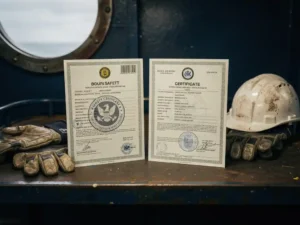
An OPITO BOSIET certificate is valid for four years. Before it expires, certificate holders must complete a FOET (Further Offshore Emergency Training) refresher course to maintain their offshore access. The FOET is shorter than the original BOSIET and is designed to refresh and update the skills already acquired.
Keeping track of certificate expiry dates is important. An expired certificate will prevent access to an offshore installation, which can cause significant delays for project timelines. Many booking departments and QHSE teams use certificate management tools or reminders to flag upcoming renewals well in advance. You can view the available OPITO FOET course options to plan your renewal in good time.
In most cases, yes. The OPITO BOSIET is a globally recognized standard, and the majority of offshore operators worldwide accept it as the baseline safety certification for visitors. However, individual operators may have additional requirements depending on the region, installation type, or company policy.
Some operators require a specific variant of the BOSIET, such as the version with an Enhanced Breathing System (EBS) or the Compressed Air Emergency Breathing System (CA-EBS). Others may require additional site-specific inductions on top of the OPITO certification. Before booking training, visitors should always confirm the exact requirements with the operator or installation manager to ensure the certificate they obtain will be accepted on arrival.
Offshore visitors can complete OPITO-accredited training at any approved OPITO training center. OPITO maintains a global network of accredited providers, and courses are available across major offshore industry hubs, including the Netherlands, the United Kingdom, Norway, the United States, France, Belgium, and the Middle East.
When choosing a training center, it is worth considering:
Checking the accreditation status of a training center before booking ensures that the certificate you receive will be recognized by operators and project managers. You can find a full overview of our training locations to identify the most convenient option for your situation.
We understand that offshore visitors often work to tight project schedules and need reliable, fast access to accredited training. At FMTC Safety, we make the process straightforward from start to finish.
Whether you are booking for yourself or coordinating training for a team, we are here to help you meet your offshore access requirements without delays or complications. View our OPITO BOSIET courses and book your place today.