

 Hotel dan
 Perubatan cek tersedia semasa pembayaran
14 Nov 2026
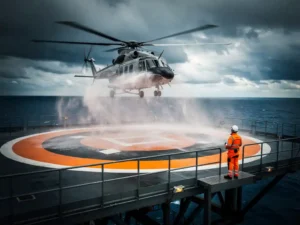
Weather directly affects helideck operations by setting hard limits on when helicopter landings and departures can safely take place. Wind speed, visibility, sea state, and precipitation all play a role in determining whether a helideck is safe to use. When conditions fall outside acceptable limits, operations are paused and crew decisions shift to managing safety on the ground. The sections below break down exactly how each weather factor works and who is responsible for making those calls.
Helideck operations become unsafe when wind speeds exceed aircraft or helideck limits, when visibility drops below the minimums required for visual flight, when precipitation reduces rotor performance or pilot sightlines, or when the helideck surface becomes iced over or contaminated. Any one of these conditions can trigger a suspension of offshore helicopter landing activities.
In practice, several conditions are monitored simultaneously. A flight might be cleared in moderate wind but grounded if fog reduces visibility at the same time. The combination of factors matters as much as any single reading. Common weather triggers that affect helideck weather limits include:
Each installation has its own operational limits, set by the helicopter operator, the installation owner, and applicable aviation regulations. These limits are not optional guidance. They are hard boundaries that define when a helideck is open or closed.
Wind speed and direction affect helicopter landings on a helideck by influencing lift, rotor stability, and the pilot’s ability to maintain a controlled approach. Most helicopters used in offshore operations have defined wind limits for landing. Direction matters because crosswinds and tailwinds are significantly more challenging to manage than headwinds of the same speed.
Helicopters perform best when approaching into a headwind, which increases lift and reduces groundspeed on final approach. A strong crosswind forces the pilot to compensate with lateral inputs, which becomes increasingly difficult as speed rises. A tailwind reduces effective lift and extends the approach distance, increasing risk during the final phase.
On a fixed offshore installation, the helideck orientation is fixed, so wind direction relative to the deck changes throughout the day. Pilots and helideck crews check wind readings before every movement. If the wind is gusting significantly or shifting direction rapidly, operations may be delayed even if the average speed is within limits. Gusts are often more dangerous than sustained high winds because they are harder to anticipate and respond to in real time.
Sea state affects helideck safety primarily on floating installations such as FPSOs, semi-submersibles, and other vessels. When wave height and period cause the platform to pitch, roll, or heave significantly, the helideck moves in ways that make landing unpredictable and potentially dangerous. On fixed platforms, sea state has less direct impact but can still affect approach conditions through spray and turbulence.
On floating structures, helideck motion limits are expressed in degrees of tilt and metres of vertical movement. If the platform exceeds these limits, landing is not permitted. The motion data is tracked continuously, and the helideck crew communicates current readings to the pilot before any approach is attempted.
High sea states can also affect offshore helicopter safety indirectly. Crew transfer by boat may be suspended at the same time, meaning personnel cannot be moved on or off the installation by either method. This creates pressure to wait out the weather rather than push operations beyond safe limits, and that pressure must be resisted. Safety protocols exist precisely for these moments.
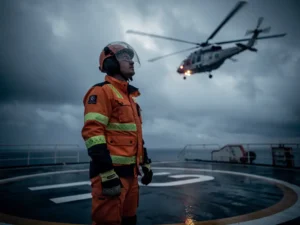
The decision to close a helideck due to weather is shared between the helicopter pilot, the Helideck Landing Officer (HLO) on the installation, and the offshore installation manager (OIM). Each has a defined role, and any one of them has the authority to stop operations. The pilot holds final authority over whether to attempt a landing or departure.
The decision-making process typically follows this order:
This layered structure means no single individual carries the full weight of the decision. It also means that a pilot who chooses not to land despite an open helideck cannot be overruled by the installation. Crew decisions in helideck operations are designed to protect against pressure from schedules or commercial interests.
Helideck crews need OPITO-certified training to manage weather-related decisions safely. The Helideck Landing Officer and Helideck Assistant roles both require formal certification that covers weather assessment, communication with pilots, emergency response, and the operational limits that govern when a helideck is open or closed. This training is mandatory for anyone working in a helideck crew role on an offshore installation.
OPITO helideck training covers the practical skills needed to read and report weather data accurately, communicate conditions clearly to pilots, and respond effectively when conditions change during an operation. Crew members learn how to use anemometers and other deck instruments, how to interpret wind readings in real time, and how to apply the installation’s specific operational limits.
Beyond the technical skills, the training also addresses decision-making under pressure. Weather windows on offshore installations can be narrow, and there is often commercial pressure to move personnel quickly. Trained helideck crews understand that safety limits are non-negotiable and are equipped to communicate this clearly to all parties involved. You can explore OPITO helideck courses to see the full range of certifications available for helideck personnel.
We understand that helideck crews need training that is practical, certified, and available when and where it is needed. At FMTC Safety, we offer OPITO-accredited helideck training for both Helideck Landing Officers and Helideck Assistants, delivered by instructors with real offshore experience. Our courses are designed to prepare crew members for the real conditions they will face, including weather-related decision-making under pressure.
Inilah caranya bekerjasama dengan kami dalam praktik:
Whether you are an individual professional looking to get certified or an HSE team coordinating training for a full helideck crew, we are here to make the process straightforward. Visit our helideck course overview to find the right certification, check availability, and book your place today.